Cleavers vs. Red Clover: How the Two Lymphatic Herbs Differ
Both herbs turn up in lymphatic blends, and both have 19th-century Eclectic roots. Beyond that, they’re very different plants. Here’s how they compare on family, chemistry, research and safety.
Cleavers and red clover sit side by side in many lymphatic blends, including ours, so it’s easy to assume they’re two versions of the same thing. They aren’t. One is a sticky spring weed, the other a pink meadow flower, and they differ in chemistry, research and safety.
This guide compares them point by point, with a table you can scan. It’s general information, not medical advice, and we’re upfront about how thin some of the evidence is.
What is the difference between cleavers and red clover?
Cleavers and red clover come from different plant families and share only a traditional purpose. Cleavers is a clinging annual whose leafy stems are used whole. Red clover is a flowering legume whose blossoms are used. Their main compounds, research and cautions all differ.
| Feature | Cleavers | Red clover |
|---|---|---|
| Latin name | Galium aparine | Trifolium pratense |
| Plant family | Rubiaceae (madder or coffee family) | Fabaceae (legume or pea family) |
| Part used | Aerial parts: the leafy stems | Flower heads (blossoms) |
| Main compounds | Iridoid glycosides (asperuloside, asperulosidic acid), flavonoids, phenolic acids | Isoflavones (biochanin A, formononetin, genistein, daidzein), traces of coumarins |
| 19th-century Eclectic use | A cooling herb,* given as a cold infusion | An “alterative,” given as a tea or tincture |
| Traditional use today | Traditionally used to support healthy lymphatic flow* | Traditionally used to support the body’s natural cleansing processes* |
| Research in people | None found; lab and chemistry studies only | Trials for menopausal symptoms and bone health, with mixed results |
| Studied for lymph? | No | No |
| Main cautions | Hooked hairs can irritate sensitive skin; little formal safety data | Pregnancy and breastfeeding, hormone-sensitive conditions, blood thinners, upcoming surgery |
| Taste | Fresh: mild and green. Dried: sour, astringent, bitter | Mild, slightly sweet and grassy |
| Common forms | Fresh juice, cold infusion, tincture, glycerite | Blossom tea, tincture, concentrated isoflavone extracts |
| In Cleavera | Cleavers aerial parts, listed first | Red clover flower, listed second |
Which plant families do cleavers and red clover belong to?
Cleavers belongs to Rubiaceae, the madder or coffee family, and red clover belongs to Fabaceae, the legume or pea family. The 1898 King’s American Dispensatory places cleavers in Rubiaceae and red clover in Leguminosae, the older name for Fabaceae.
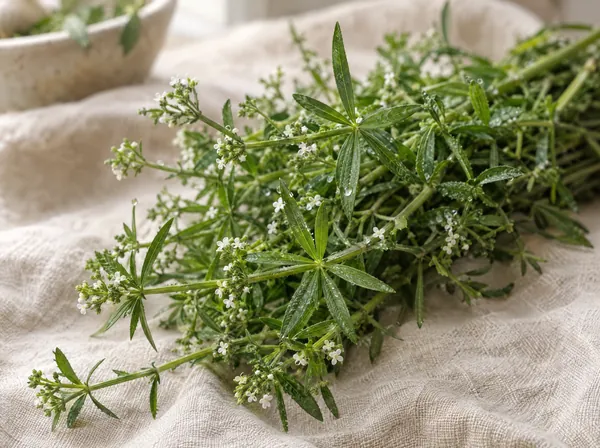
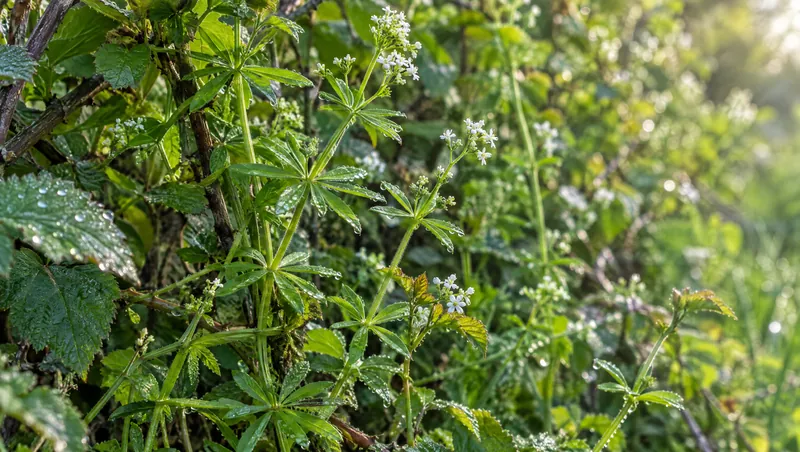
Cleavers is a scrambling annual that grabs onto everything it touches. Penn State Extension describes its hook-like hairs, which is why it goes by names such as sticky willy, grip grass and Velcro plant. King’s lists goose-grass, catch-weed and bedstraw too. The part used is the herb itself: the stems, leaves and tiny flowers that grow above ground. Our guide on how to identify cleavers covers its whorled leaves and look-alikes.
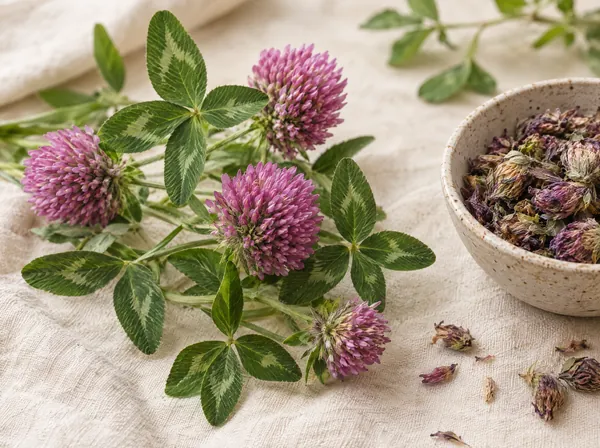
Red clover is, in the words of the NIH’s National Center for Complementary and Integrative Health (NCCIH), a legume “like peas and beans,” native to Europe, central Asia and northern Africa. Only its rounded, rose-pink flower heads are used. King’s is specific: “The blossoms or flowers are the parts used.”
The family split matters because related plants tend to share chemistry. That’s the root of most of the differences below.
How were cleavers and red clover used traditionally?
Both were part of 19th-century Eclectic medicine, an American school of physicians who relied on native and botanical remedies, and both have entries in King’s American Dispensatory, the movement’s standard reference.
The Eclectics used them quite differently. They valued cleavers as a cooling herb* and gave it cold: about 1½ ounces of herb steeped in a pint of warm water for two hours, taken a few ounces at a time. King’s warned that “boiling destroys” its virtues. Red clover was taken more freely, as an infusion of one ounce of blossoms to a pint of water or a strong tincture of recently dried flowers, and King’s called it “an excellent alterative,” a historical class of herbs taken steadily over time.
Today, cleavers is traditionally used to support healthy lymphatic flow,* and red clover flower is traditionally used to support the body’s natural cleansing processes.* Traditional use tells you how people valued a plant, not what it does in your body. For the fuller story of both herbs and their two companions in our formula, read the herbal tradition behind cleavers, red clover, stillingia and prickly ash.
What compounds are in cleavers and red clover?
Cleavers is best known for iridoid glycosides, flavonoids and phenolic acids, while red clover is best known for isoflavones, with small amounts of coumarins.
Cleavers: iridoids, flavonoids and phenolic acids
A 2023 lab analysis of Galium species from Estonia found that asperulosidic acid was the most abundant compound in cleavers herb, alongside its close relative asperuloside. Both are iridoid glycosides, a group typical of the genus. The extracts also contained flavonoids such as rutin and quercetin, and phenolic acids such as chlorogenic acid. These compound groups are a different chemical family from red clover’s isoflavones.
Red clover: isoflavones and coumarins
Red clover’s signature compounds are four isoflavones: biochanin A, formononetin, genistein and daidzein. NCCIH explains that isoflavones are structurally similar to estrogen. When researchers profiled a red clover extract prepared for a yearlong menopause trial, isoflavones made up about 35.5% of it, and coumarins no more than 0.03%. Those trace coumarins come up again in the safety section.
Plant chemistry shifts with the growing site, the season, the part harvested and the way it’s extracted. These lists describe the plants, not any particular product.
What does research show for cleavers vs. red clover?
Cleavers has only lab and chemistry studies, while red clover has been tested in people, mainly for menopausal symptoms, with mixed results. Neither has been studied in clinical trials for lymphatic flow.
Cleavers. We found no human clinical trials of cleavers for any purpose. The research that exists measures its compounds and tests extracts in the lab, like the 2023 Estonian study, which measured antioxidant activity in test tubes. Results like these can’t tell you what a cup of tea or a few drops does in the body.
Red clover. Concentrated red clover extracts have been through human trials, and NCCIH summarizes them plainly: no conclusive evidence of benefit for any health condition. Studies of menopausal hot flashes have had inconsistent results. Only a small number of studies have looked at bone density, also with inconsistent results. Findings on cholesterol after menopause conflict. On the safety side, NCCIH notes that red clover extracts have been used in clinical studies for up to two years and appear to be well tolerated. We found no studies of red clover for lymphatic flow.
The same is true of combination products, ours included: Cleavera hasn’t been tested in clinical trials. Our article asking whether lymphatic drainage drops work looks at the evidence for the whole category.
Is cleavers or red clover safer?
Red clover has more known cautions than cleavers, mostly because of its isoflavones and a possible interaction with blood thinners. Cleavers’ best-known problem is skin irritation from handling it, though formal safety research on cleavers is thin, so “fewer known cautions” isn’t the same as “proven safe.”
Red clover cautions
- Pregnancy and breastfeeding. NCCIH says red clover supplements may be unsafe during pregnancy or while breastfeeding.
- Hormone-sensitive conditions. Because isoflavones resemble estrogen, talk to a clinician first if you have a current or past hormone-sensitive condition, or use hormone therapy or hormonal birth control.
- Blood thinners. In a lab study, red clover slowed CYP2C9, a liver enzyme that helps clear the blood thinner warfarin, and the plant contains traces of natural coumarins. For those reasons, some reviews list red clover as a possible bleeding risk. A 2014 review of herb and warfarin interactions rated the human evidence, a single case report involving several herbs at once, as doubtful. Doubtful isn’t the same as safe, so ask your prescriber before using red clover in any form if you take an anticoagulant or antiplatelet medicine.
- Upcoming surgery. The American Society of Anesthesiologists asks patients to tell their anesthesiologist about every supplement they take, and notes that some may be asked to stop supplements at least two weeks before a procedure. That matters more for red clover because of the blood-thinner question.
Our full guide to red clover’s benefits, isoflavones and safety goes deeper on each point.
Cleavers cautions
- Skin. Penn State Extension notes that cleavers’ scratchy hairs can irritate people with sensitive skin, and suggests wearing gloves.
- Thin safety data. With no human trials, there’s little formal safety information. Ask a clinician first if you’re pregnant or breastfeeding, want to give it to a child, or take medication.
- Identification. If you forage it, be certain of the plant and the site. Our guide to making cleavers tea covers safe gathering.
For the whole formula, see lymphatic drops side effects and who should skip them, and lymphatic drops during pregnancy and breastfeeding, which explains why Cleavera isn’t for those times.
How do cleavers and red clover taste, and what forms do they come in?
Fresh cleavers tastes mild and green, while red clover blossoms make a gentle, slightly sweet and grassy cup. Cleavers is at its best fresh in spring; red clover is usually dried.
Cleavers was traditionally taken fresh in spring, as a pressed juice or a cold infusion. King’s described the dried herb as odorless, with a sour, astringent and bitter taste. Today you’ll also find it as an alcohol tincture or an alcohol-free glycerite. Try it at home with our guide on how to make cleavers tea.
Red clover is most often sold as dried blossoms for tea, or as a tincture; King’s described a strong tincture made from recently dried flowers. Most clinical studies, though, used concentrated extracts measured by their isoflavone content, which is a very different product from a cup of blossom tea. A homemade tea has no stated isoflavone content at all.
In liquid extracts the base matters too: alcohol tinctures taste sharp, while glycerites taste mild and lightly sweet. Our comparison of glycerites and tinctures explains the trade-offs.
Can you take cleavers and red clover together?
Yes, and they’re often combined in lymphatic blends, but combining them doesn’t remove red clover’s cautions. The pairing of red clover with other herbs is old: King’s describes an Eclectic-era product, an “Extract of Trifolium Compound,” that combined red clover with other plant extracts, including a prickly ash tincture.
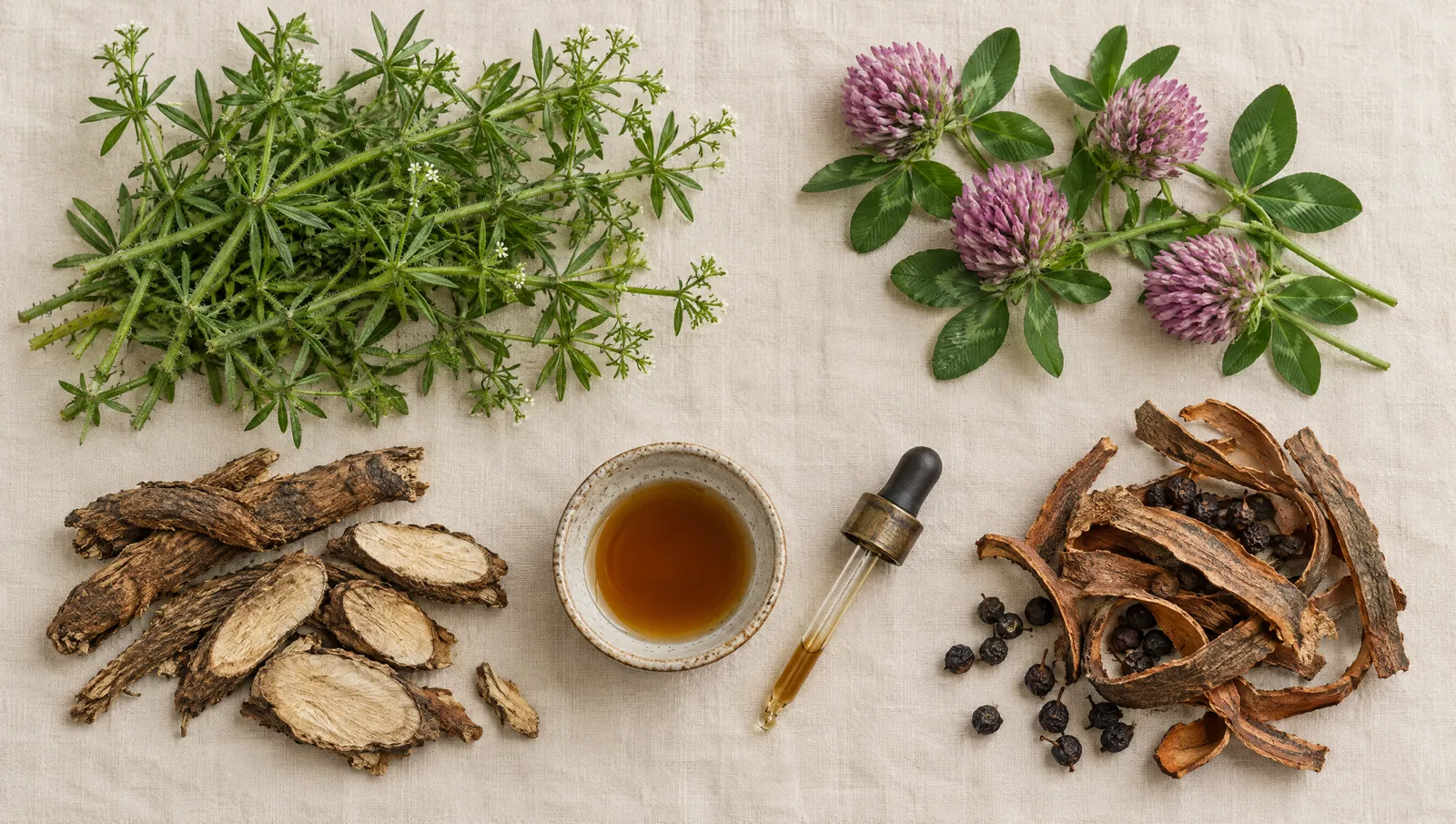
Cleavera follows that tradition. Each 1 mL serving holds a 300 mg proprietary blend of cleavers aerial parts (Galium aparine), red clover flower (Trifolium pratense), stillingia root (Stillingia sylvatica) and prickly ash bark (Zanthoxylum americanum), in vegetable glycerin and water. Together, the four herbs are traditionally used to support healthy lymphatic flow.* Proprietary blends list their herbs from most to least by weight, and cleavers comes first on our label, red clover second. The label doesn’t state each herb’s amount or an isoflavone content.
Because the blend contains red clover, every red clover caution above applies to it. You can read the full Supplement Facts on the Lymphatic Drainage Drops page, meet all four plants on our ingredients page, or read about the other two in our stillingia root guide and our prickly ash bark guide.
Should you choose cleavers or red clover?
It depends on what matters most to you, since neither has been shown to work better for lymphatic flow. Cleavers has fewer known cautions. Red clover has more human research, though none of it on lymph. Many lymphatic blends simply use both.
- Cleavers may suit you if you want a mild, traditional spring herb and don’t mind that the evidence is limited to tradition and lab work.
- Red clover is best skipped during pregnancy and breastfeeding, and needs a clinician’s okay first if you’re hormone-sensitive, on hormone therapy or hormonal birth control, taking a blood thinner, or scheduled for surgery.
- A blend gives you both plants in one serving, with red clover’s cautions included.
Whatever you choose, keep up the everyday basics that help lymph move, like walking, deep breathing and staying hydrated, and stop if something doesn’t agree with you.
Check before you combine. Cleavera is for adults only. Talk to your healthcare professional before use if you’re pregnant or nursing, take medication (including blood thinners or hormone therapy), have a hormone-sensitive or bleeding condition, or have surgery scheduled. Red clover naturally contains plant isoflavones. Stop use if you experience nausea or digestive upset.
Further reading: drops vs. capsules vs. tea and how to choose lymphatic drops.
Frequently asked questions
Is cleavers the same as red clover?
No. Cleavers (Galium aparine) is a clinging, leafy herb in the coffee family, used whole. Red clover (Trifolium pratense) is a legume whose pink flower heads are used. They share a traditional use, supporting healthy lymphatic flow,* but differ in chemistry, research and safety.
Which is better for lymph, cleavers or red clover?
Neither has been shown to be better, because neither has been tested for lymphatic flow in clinical trials. Both are traditionally used to support healthy lymphatic flow,* and they’re often combined in lymphatic blends. Cleavers has fewer known cautions; red clover has more human research, though none of it on lymph.
Why does red clover have more cautions than cleavers?
Mostly because of its isoflavones, plant compounds structurally similar to estrogen, and a possible interaction with blood thinners. NCCIH says red clover supplements may be unsafe during pregnancy or breastfeeding. Cleavers’ best-known compounds are iridoid glycosides, and its main known issue is skin irritation when it’s handled.
Can you take cleavers and red clover together?
Yes. They’re often paired in lymphatic blends, including Cleavera, which adds stillingia and prickly ash. Combining them doesn’t remove red clover’s cautions, so check with a clinician first if you’re pregnant or nursing, hormone-sensitive, taking a blood thinner or scheduled for surgery.
What part of each plant is used?
For cleavers, the aerial parts: the leafy stems, often gathered fresh in spring. For red clover, the flower heads, which King’s American Dispensatory named as the part used in 1898. Cleavera’s label lists cleavers aerial parts and red clover flower.
Sources
- NIH National Center for Complementary and Integrative Health. “Red Clover: Usefulness and Safety.” nccih.nih.gov/health/red-clover
- Booth, N. L., et al. Journal of Alternative and Complementary Medicine (2006), via PubMed Central. “The Chemical and Biological Profile of a Red Clover (Trifolium pratense) Phase II Clinical Extract.” pmc.ncbi.nlm.nih.gov/articles/PMC1780253
- Laanet, P.-R., et al. Molecules (2023), via PubMed Central. “Phytochemical Screening and Antioxidant Activity of Selected Estonian Galium Species.” pmc.ncbi.nlm.nih.gov/articles/PMC10056973
- Ge, B., et al. Evidence-Based Complementary and Alternative Medicine (2014), via PubMed Central. “Updates on the Clinical Evidenced Herb-Warfarin Interactions.” pmc.ncbi.nlm.nih.gov/articles/PMC3976951
- American Society of Anesthesiologists. “Herbal and Dietary Supplements and Anesthesia.” madeforthismoment.asahq.org/…/ASA_Supplements-Anesthesia_Updated-1.pdf
- Penn State Extension. “Getting the Best of Catchweed Bedstraw.” extension.psu.edu/getting-the-best-of-catchweed-bedstraw
- Felter, H. W. & Lloyd, J. U. King’s American Dispensatory (1898), via Henriette’s Herbal Homepage. “Galium.—Cleavers.” henriettes-herb.com/eclectic/kings/galium
- Felter, H. W. & Lloyd, J. U. King’s American Dispensatory (1898), via Henriette’s Herbal Homepage. “Trifolium.—Red Clover.” henriettes-herb.com/eclectic/kings/trifolium-prat
Like our guides? Add Cleavera as a preferred source on Google and our articles can show up more often for you in Google’s Top Stories and AI answers.