The Herbal Tradition Behind Cleavers, Red Clover, Stillingia & Prickly Ash
Long before they shared a bottle, these four plants had stories of their own: in hedgerows and meadows, in folk spring tonics, and in the notebooks of 19th-century American physicians.
Every herb in Cleavera has a past. Some grew wild along European lanes and field edges. Others were native to North American woodlands and sandy pinelands. Their paths crossed in the 1800s, when a group of American doctors known as the Eclectics set out to study and record the medicinal plants of a young country.
This is a history, not a promise. Traditional use tells us how people valued a plant; it doesn’t prove what a plant does. We’ll be clear throughout about where tradition ends and modern evidence begins.
Who were the Eclectic physicians?
The Eclectics were 19th-century American doctors who built their practice around medicinal plants, especially those native to North America. In the early 1800s, mainstream medicine still leaned on harsh treatments such as bloodletting and mercury compounds. A group of physicians who came to be called Eclectics took a different path. As the name suggests, they selected what they considered the best of several traditions, with a strong emphasis on plants native to North America.
The Eclectics drew on Indigenous plant knowledge, frontier folk practice and European herbal tradition, and they built their own medical schools. The best known, the Eclectic Medical Institute in Cincinnati, trained physicians for nearly a century. According to its records at Cincinnati’s Lloyd Library, the school received its Ohio charter in 1845 and became the country’s leading Eclectic college. Eclectic physicians and pharmacists wrote detailed references describing plants, preparations and how they were used. Works such as King’s American Dispensatory are still read today as a historical record.
As medical science and education changed in the early 20th century, the movement faded, and the Cincinnati school graduated its final class in 1939. The movement’s writings, though, preserved a detailed picture of how American physicians once used plants, including all four in Cleavera.
Alteratives and spring tonics
Eclectic writers often grouped herbs by their broad action. One group was the “alteratives,” plants thought to gradually nudge the body back toward healthy function when taken steadily over time. It’s an old idea rooted in the medicine of the era, and modern medicine doesn’t use the term.
Ordinary households had their own version: the spring tonic. After long winters of stored food, families in rural Europe and America welcomed the first fresh greens of the year as teas, juices and simple soups. Cleavers was among the most familiar spring herbs, and red clover blossoms followed as the meadows bloomed.
Cleavers (Galium aparine): the hedgerow herb
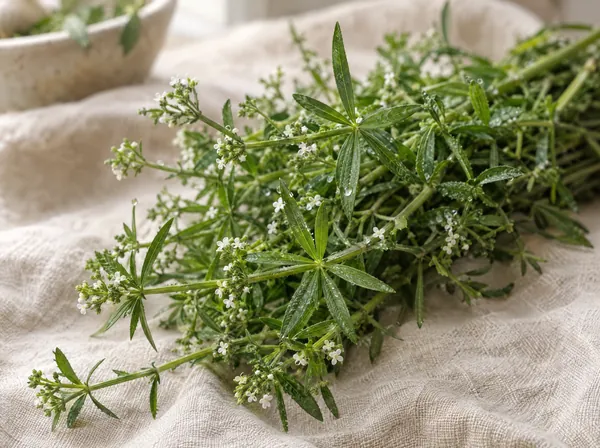
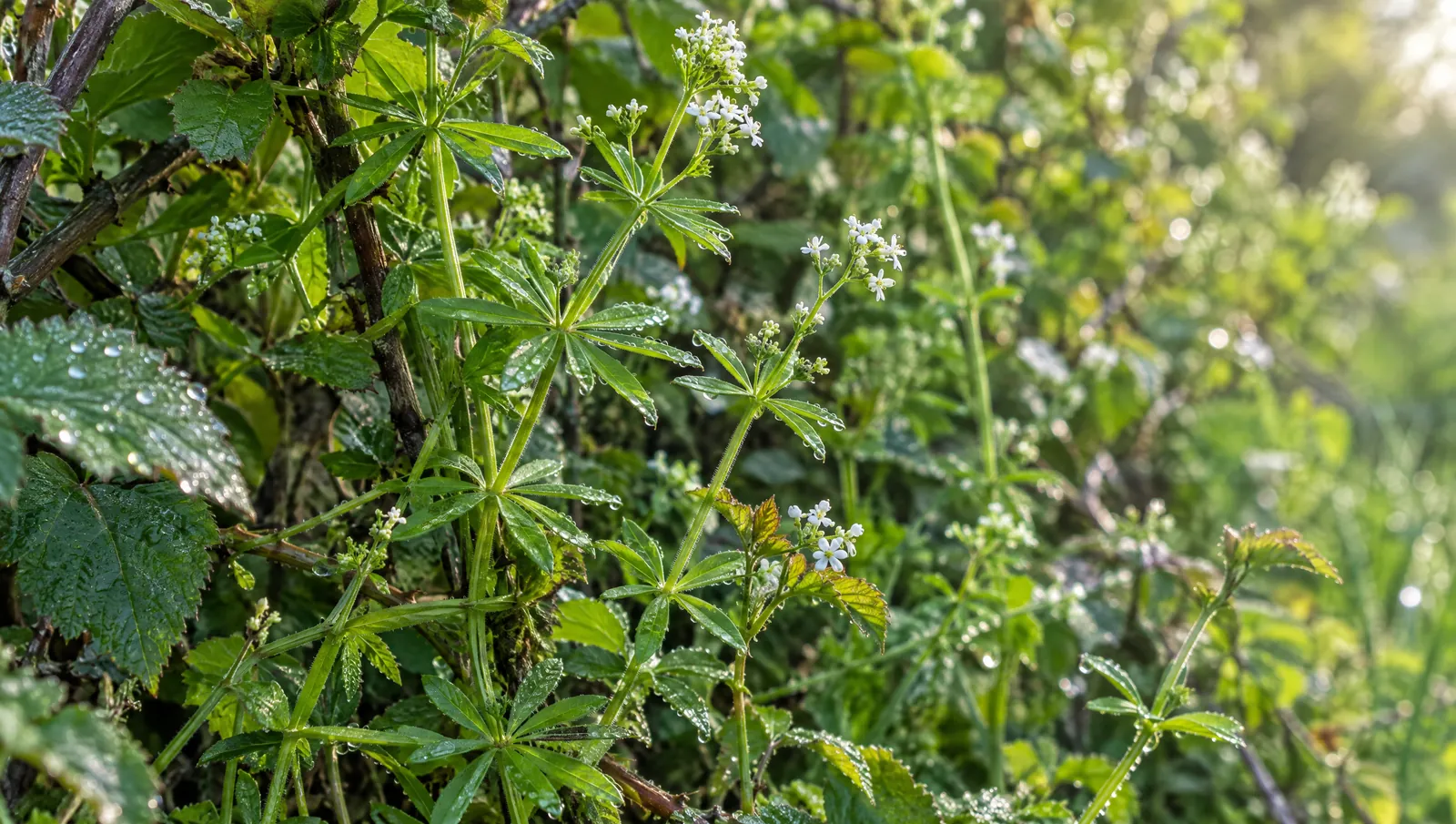
If you’ve ever walked past a hedge in spring and found small, sticky stems clinging to your sleeves, you’ve met cleavers. Tiny hooked hairs cover its stems, leaves and round seeds. That grip earned it folk names such as goosegrass, catchweed, sticky willy and clivers; the 1898 King’s American Dispensatory lists “Cleavers, Goose-grass, Catch-weed, Bedstraw.” The name “cleavers” itself comes from the old sense of the verb “cleave”: to cling. To recognize it in the wild, see our guide to how to identify cleavers.
The plant belongs to the same botanical family as coffee, and its roasted seeds have reportedly been used as a coffee substitute. Farmers noticed that geese loved it, hence “goosegrass.” In parts of Europe, the tangled stems were reportedly even used as a rough sieve for straining milk.
In European and later American herbal practice, the cleavers herb was a classic spring plant, usually taken fresh as a juice or infusion. Herbalists came to regard it as one of the gentlest “lymphatic” herbs, and it remains one of the best-known plants traditionally used to support healthy lymphatic flow.* It’s also the hedgerow herb behind our name.
Red clover (Trifolium pratense): the meadow blossom
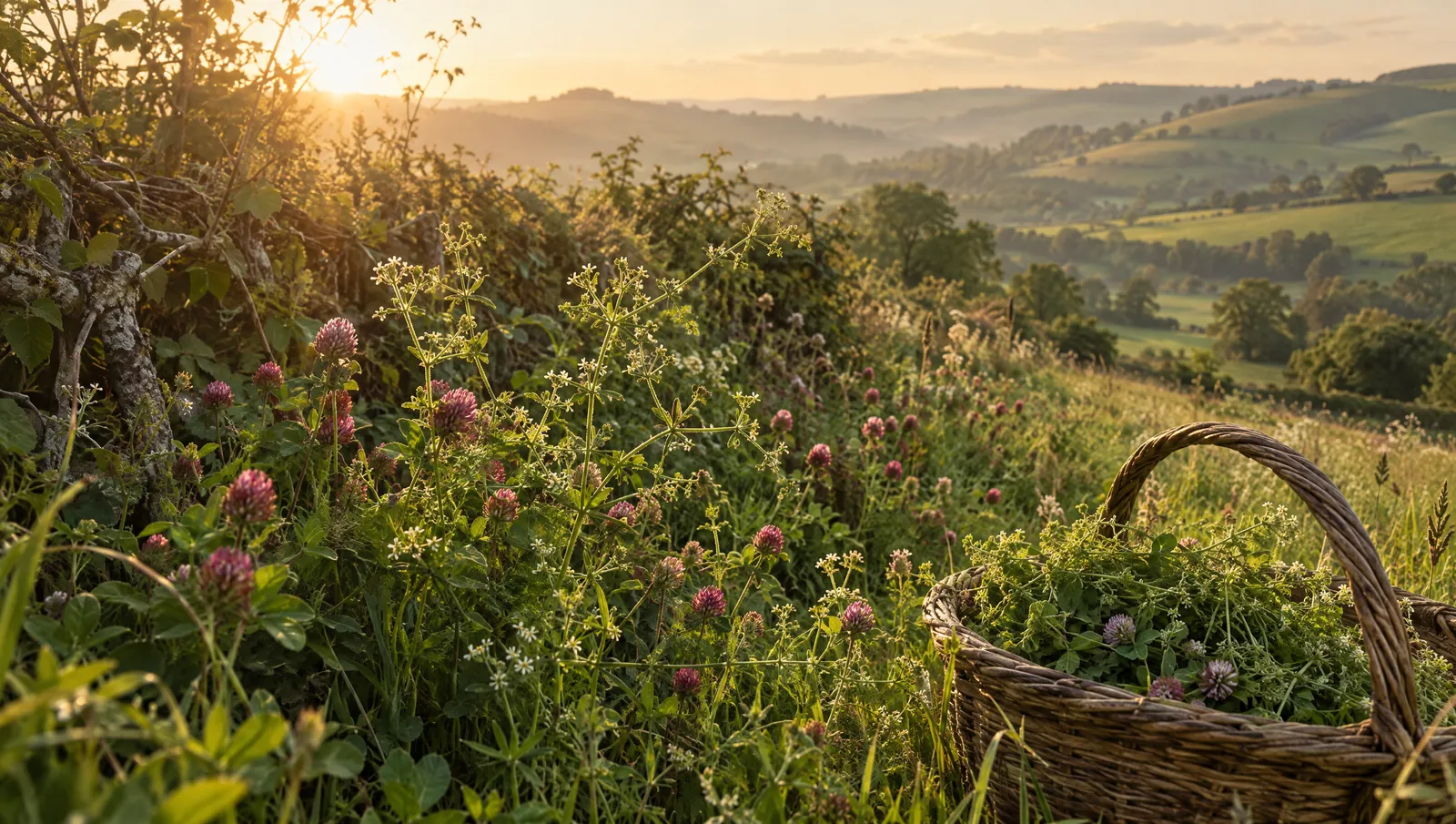
Red clover is a familiar sight in pastures across Europe and North America, where farmers have long grown it as forage and to enrich the soil. Like other legumes, it partners with soil bacteria to capture nitrogen from the air. Its rounded pink-purple flower heads are a favorite of bees, and Vermont law names it the state flower.
The blossoms have a long history as a gentle tea in folk practice. By the late 1800s, red clover flowers appeared regularly in American herbal references and in compound syrups sold by pharmacists, usually alongside other herbs rather than on their own. Today, red clover flower is traditionally used to support the body’s natural cleansing processes.*
When people search for red clover benefits, they often find modern research rather than history. Scientists have taken an interest in red clover because it contains isoflavones, plant compounds with weak estrogen-like activity. The NIH’s National Center for Complementary and Integrative Health (NCCIH) notes that research on red clover has produced mixed results and that red clover supplements may be unsafe during pregnancy or breastfeeding. Because its isoflavones are structurally similar to estrogen, people with hormone-sensitive conditions should also ask a clinician first. That’s one reason we’re careful with safety guidance.
Stillingia (Stillingia sylvatica): queen’s root
Stillingia is a low-growing perennial native to the southeastern United States, at home in sandy soils, open pinewoods and dry fields. Its common names, queen’s root and queen’s delight, hint at the regard it once held. The part used is the thick, woody stillingia root.
Stillingia became a staple of 19th-century American practice, where Eclectic physicians and pharmacists frequently combined it with other herbs in syrups and compound preparations. They were careful with it, too. The root is acrid, and the plant belongs to the spurge family, many members of which contain irritating compounds. Practitioners used it in small amounts and noted that larger doses could upset the stomach; King’s American Dispensatory warned that “in large doses, stillingia vomits and purges.”
That traditional caution still applies today. Stillingia is used only in small amounts as part of a blend, and anyone who experiences nausea should stop.
Prickly ash (Zanthoxylum americanum): the toothache tree
Northern prickly ash is a thorny shrub or small tree native to eastern and central North America. It shares a genus with the plants that give us Sichuan pepper, and like them, its bark and berries produce a distinctive tingling, warming sensation in the mouth.
That tingle gave the plant its most memorable nickname: the toothache tree. Several Indigenous nations used prickly ash bark and berries in their traditional medicine, including chewing the bark for sore teeth, and European settlers took up the practice.
The Eclectics valued prickly ash bark as a warming herb associated with circulation, and it often appeared in formulas as a supporting ingredient. Today it’s traditionally used to support healthy circulation.*
The four herbs at a glance
| Herb | Part used | Where it grows | Folk names | Traditional role |
|---|---|---|---|---|
| Cleavers | Aerial parts | Widespread across the Northern Hemisphere | Goosegrass, clivers, sticky willy | Spring herb; traditionally used to support healthy lymphatic flow* |
| Red clover | Flower | Native to Europe, central Asia and northern Africa; now grown widely, including in North America | Meadow clover | Gentle folk tea; traditionally used to support the body’s natural cleansing processes* |
| Stillingia | Root | Southeastern United States | Queen’s root, queen’s delight | Used sparingly in 19th-century American herbal blends |
| Prickly ash | Bark | Eastern and central North America | Toothache tree | Warming herb; traditionally used to support healthy circulation* |
Why combine these four herbs?
Formulas that combined several of these plants were common in American herbal practice by the late 1800s. Within that tradition, the pairing makes intuitive sense. Cleavers and red clover were gentle, everyday herbs. Stillingia was a stronger root used sparingly. Prickly ash was a warming partner traditionally associated with circulation.
What modern research says, and doesn’t
Honesty matters here. Traditional use spans generations, but it isn’t the same as clinical evidence. Modern research on cleavers, stillingia and prickly ash in people is limited, and studies on red clover have mostly focused on other questions, with mixed results. We aren’t aware of large clinical trials showing that these herbs, alone or together, change lymphatic function. We look at the evidence more closely in Do Lymphatic Drainage Drops Work? An Honest Look at the Evidence.
That’s why we describe Cleavera as traditionally used to support healthy lymphatic flow,* and why we encourage the everyday habits that matter most: movement, hydration, deep breathing and rest. Our guide to 10 daily habits for healthy lymph flow is a good place to start.
History is not a dosing guide. Historical texts describe preparations and amounts that don’t apply to modern products, so use any herbal supplement only as directed on its label. Talk to your healthcare professional before use if you’re pregnant or nursing, take medication (especially blood thinners or hormone therapy), have a hormone-sensitive or bleeding condition, or have surgery scheduled. Never gather or eat wild plants unless you’re certain of their identity. Read more in Lymphatic Drainage Drops: Side Effects & Who Should Skip Them.
Bringing tradition into a modern bottle
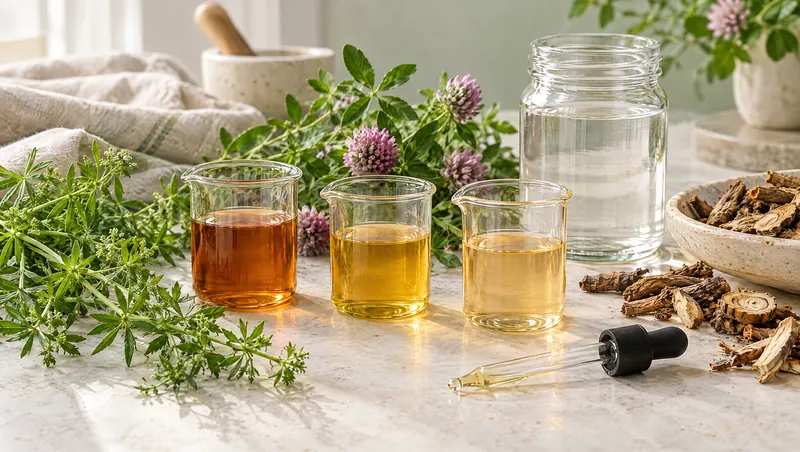
We named Cleavera after the humble hedgerow herb, and we built the formula around the same four plants that appear again and again in American herbal history. Each is named on the label by plant part: cleavers aerial parts, red clover flower, stillingia root and prickly ash bark. They’re extracted in vegetable glycerin and water, with no alcohol.
Learn more about each plant on our ingredients page, read why we chose a glycerite over a tincture, see how it works, or visit the Lymphatic Drainage Drops page.
Frequently asked questions
What is cleavers herb traditionally used for?
Cleavers (Galium aparine) is a hedgerow plant with a long history in European and American folk herbalism, especially as a fresh spring herb. In Western herbal tradition it’s one of the classic plants traditionally used to support healthy lymphatic flow.* Modern clinical research on it is limited.
What are the traditional uses of red clover?
Red clover blossoms were brewed as a gentle tea in folk practice and appeared in many 19th-century American herbal preparations. Today they’re traditionally used to support the body’s natural cleansing processes.* Red clover contains plant isoflavones, so anyone who is pregnant or has a hormone-sensitive condition should talk to a healthcare professional first.
Is prickly ash bark related to Sichuan pepper?
Yes. Northern prickly ash (Zanthoxylum americanum) shares a genus with the plants that produce Sichuan pepper, which is why both create a tingling sensation in the mouth. Prickly ash bark is traditionally used to support healthy circulation.*
Why is stillingia root used only in small amounts?
Stillingia belongs to the spurge family, and its root is acrid. Historical practitioners used it sparingly and noted that larger amounts could cause nausea and digestive upset. Use any product containing stillingia only as directed on the label.
Sources
- Felter, H. W. & Lloyd, J. U. King’s American Dispensatory (1898), via Henriette’s Herbal Homepage. “Galium.—Cleavers.” henriettes-herb.com/eclectic/kings/galium
- Felter, H. W. & Lloyd, J. U. King’s American Dispensatory (1898), via Henriette’s Herbal Homepage. “Stillingia.” henriettes-herb.com/eclectic/kings/stillingia
- Felter, H. W. & Lloyd, J. U. King’s American Dispensatory (1898), via Henriette’s Herbal Homepage. “Xanthoxylum.” henriettes-herb.com/eclectic/kings/xanthoxylum
- NIH National Center for Complementary and Integrative Health. “Red Clover: Usefulness and Safety.” nccih.nih.gov/health/red-clover
- Lloyd Library and Museum. “Eclectic Medical College Records, 1845–1942” (collection finding aid). lloydlibrary.org/…/Eclectic-Medical-Institute.pdf
- Vermont General Assembly. “1 V.S.A. § 498. State flower.” legislature.vermont.gov/statutes/section/01/011/00498