Do Lymphatic Drainage Drops Work? An Honest Look at the Evidence
It’s the question we hear most, and we make lymphatic drops. Here’s what the research does and doesn’t show, what “traditionally used” really means, and how to judge any brand’s promises, including ours.
Search for lymphatic drainage drops and you’ll find two kinds of answers. Product pages promise dramatic changes. Skeptics call the whole category nonsense. The truth sits somewhere quieter, and it’s worth knowing before you buy any bottle, ours included.
Here’s where the evidence stands, why traditional use still matters to many people, and how to set expectations and read reviews. It’s general information, not medical advice.
What would it mean for lymphatic drops to “work”?
It would mean the drops measurably change how lymph moves in people, and no published study has tested that. Lymph flow isn’t something you can see, feel or measure at home, which is why so many claims about it are hard to check.
Some background helps. According to Cleveland Clinic, about 20 liters of plasma seep out of your tiniest blood vessels each day. Around 17 liters return directly, and the remaining 3 liters or so are collected by lymphatic vessels and become lymph. That fluid travels through vessels with one-way valves and roughly 600 lymph nodes, helped along by nearby muscles squeezing and arteries pulsing, before it rejoins the blood.
So when a product says you’ll “feel your lymph moving,” there’s no way for you, or the brand, to confirm it.
What does the research say about the herbs in lymphatic drops?
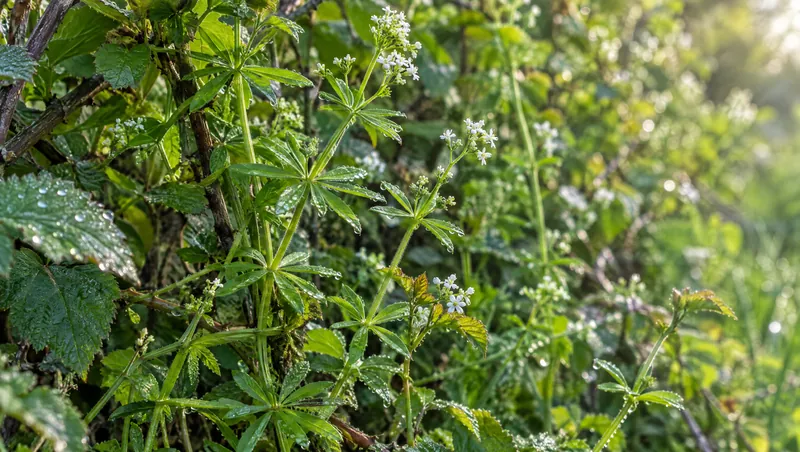
Very little in people. The four classic herbs, cleavers, red clover, stillingia and prickly ash, have mostly been studied in the lab, if at all, and we found no clinical trials testing any of them for lymphatic support.
We searched PubMed, the National Library of Medicine’s research database, in October 2026. Here’s what we found.
Cleavers (Galium aparine)
Cleavers has a monograph in the British Herbal Pharmacopoeia, and its extracts appear in herbal products sold in Europe, according to a 2020 study in the journal Molecules. That study was done in the lab: researchers profiled the plant’s chemistry and tested a cleavers infusion on blood cells in a dish. Lab work is a starting point, not evidence of what a daily serving does in your body. PubMed lists no clinical trials of cleavers in people.
Red clover (Trifolium pratense)
Red clover is the best studied of the four, but not for lymph. According to the NIH’s National Center for Complementary and Integrative Health (NCCIH), human studies have looked mainly at hot flashes, cholesterol and bone density, and haven’t shown conclusive benefit for any health condition. Red clover contains isoflavones, plant compounds structurally similar to estrogen, and NCCIH notes that red clover supplements may be unsafe during pregnancy or breastfeeding.
Stillingia (Stillingia sylvatica) and prickly ash (Zanthoxylum americanum)
These two have barely been studied. A PubMed search for Stillingia sylvatica returns a single record, and it isn’t a human study. Research on prickly ash amounts to a handful of lab studies on compounds from its bark. We found no studies of either herb in people.
Why a combination is its own question
Even strong evidence for one herb wouldn’t settle the question for a blend. The Federal Trade Commission’s Health Products Compliance Guidance points out that studies of individual ingredients may not support claims about a combination, because ingredients can interact, and that a different extract of the same plant can have a different chemical profile. We found no published clinical trials of any combination lymphatic drop formula in people, including ours.
Does traditional use count as evidence?
It counts as history, not proof. A long tradition tells you that generations of herbalists chose these plants and kept using them. It doesn’t tell you what a specific product does, at a specific dose, in your body.
That history is why we chose these four herbs, and you can read it in the herbal tradition behind cleavers, red clover, stillingia and prickly ash. The FTC’s guidance draws the same line. It says traditional-use claims face the same substantiation standard as any other health claim, and that a carefully qualified traditional-use statement must match the tradition in ingredients, dose and form. That’s why we write that our herbs are traditionally used to support healthy lymphatic flow,* with an asterisk, rather than promising an effect.
Regulation matters here too. The NIH’s Office of Dietary Supplements explains that the FDA does not determine whether supplements are effective before they’re sold.
How long do lymphatic drops take to work?
No study has established a timeline, so any specific number of days is a guess. If you try an herbal routine, take it as directed for at least a few weeks and judge it by how the whole routine fits your life.
A simple way to set expectations before you start:
- Decide why you’re trying it. Enjoying a daily herbal ritual is a realistic goal. Fixing a medical problem is not.
- Change one thing at a time. If you start drops, a walking habit and a new diet in the same week, you won’t know what made a difference.
- Set a check-in date. Three or four weeks out, ask whether the routine is easy, affordable and enjoyable.
- Keep brief notes. A line a day beats memory.
- Stop if something feels wrong. Digestive upset or any unusual reaction is a reason to stop and talk to your clinician. Our guide on how to take lymphatic drainage drops covers the routine itself.
Why do some people say lymphatic drops made a difference?
Because how you feel is shaped by many things at once. Taking drops often comes with drinking more water, moving more and paying closer attention to your body. Expectation and ordinary day-to-day variation play a part too.
- The habits that come with it. A serving stirred into water is also a glass of water, and many people start walking or stretching at the same time.
- Natural ups and downs. Sleep, heat, salty meals and long days at a desk all change how you feel.
- Timing. People tend to start something new when they feel their worst, and feeling better a few weeks later can happen either way. Statisticians call this regression to the mean.
- Expectation. Believing something will help can change how you feel. That’s the placebo effect, and it’s why good trials compare a product with a look-alike dummy.
None of this means people are imagining things. It means one person’s story can’t tell you what caused a change. The FTC’s guidance is blunt on this point: anecdotes are never enough to show that a health product works.
How should you read lymphatic drops reviews?
Read them for practical details, such as taste, packaging and customer service, not as proof of results. Reviews can be bought, filtered or invented, and even honest ones describe one person’s experience.
| What you see | What it can tell you | What to watch for |
|---|---|---|
| A high star rating | General satisfaction with taste, shipping and service | Hundreds of five-star reviews with no criticism at all |
| Before-and-after photos | Very little; lighting, angle, posture and time of day change a photo | Photos used as proof of a body change |
| “It worked in three days” | One person’s impression | Ads or reviews that promise a timeline |
| Reviews naming medical conditions | Nothing about what a supplement does for them | A brand that features them, which signals a disease claim |
| Detailed, mixed reviews | The most useful kind: what people liked and didn’t | Identical wording across many reviews |
A Federal Trade Commission rule announced in August 2024 bans fake reviews, including AI-generated ones, paying for reviews that must be positive or negative, undisclosed insider reviews and suppressing negative ones. The FDA has long warned that personal “success” stories are easy to make up and are no substitute for scientific evidence.
What can you realistically expect from lymphatic drops?
A simple daily ritual built on traditional herbs, and nothing you should rely on for a health problem. Drops can sit alongside the basics, which are where the evidence is.
| Realistic | Not realistic |
|---|---|
| A consistent habit that pairs each serving with a drink of water | Visible changes within days |
| A traditional herbal blend many people enjoy as part of a routine | A substitute for movement, sleep or medical care |
| A brand that’s clear about what its product is and isn’t | Any change you can measure at home |
The habits with the clearest link to lymph flow are free. Cleveland Clinic lists regular exercise and drinking plenty of water among the basics for a healthy lymphatic system. Our guides to daily habits for healthy lymph flow, how lymph moves and exercise for lymph flow cover them, and our guide to how lymphatic drainage drops work explains the routine.
How does Cleavera handle claims?
We’d rather under-promise. These are the rules we hold ourselves to:
- We describe our herbs as traditionally used to support healthy lymphatic flow and circulation,* and we don’t claim more.
- We don’t publish before-and-after photos or results timelines.
- We don’t invent reviews, ratings or customer counts.
- Our label names all four herbs, the plant part used for each, and the only other ingredients: vegetable glycerin and water.
If that approach suits you, the Lymphatic Drainage Drops page has the full Supplement Facts. If you’re comparing brands, our label-reading guide on how to choose lymphatic drops walks through what to check.
See a doctor, not a supplement, for new symptoms. Lymphatic drops aren’t designed to address any symptom. See a doctor about new swelling, especially in one limb, or swelling with pain, redness or warmth, and about any lump or change that doesn’t go away. Cleavera is for adults only. Talk to your healthcare professional first if you’re pregnant or nursing, take medication (including blood thinners or hormone therapy), have a hormone-sensitive or bleeding condition, or have surgery scheduled.
Frequently asked questions
Are lymphatic drainage drops FDA approved?
No. Dietary supplements don’t go through FDA approval before they’re sold. Companies are responsible for making sure their products are safe and their label claims are truthful, and they must follow FDA manufacturing rules. The FDA can act against unsafe or mislabeled products once they’re on the market.
Is there any downside to trying lymphatic drops?
The main downsides are cost, possible digestive upset and, for some people, ingredient concerns. Red clover contains isoflavones, and herbs can interact with medicines. If you’re pregnant, nursing, take medication or have surgery planned, ask your clinician first. Our side-effects guide explains who should skip them.
Can lymphatic drops replace lymphatic massage or exercise?
No. They’re different things. Muscle movement and deep breathing help push lymph along, and gentle self-massage is a hands-on ritual many people enjoy. Drops are a traditional herbal supplement. If you like them, use them alongside the basics, never instead of them or instead of medical care.
What does the asterisk next to supplement claims mean?
It links to a statement the FDA requires beside structure/function claims, saying the FDA hasn’t evaluated the claim and the product isn’t intended for any disease. It’s a reminder that the wording describes support for normal body function, not a medical effect.
Why doesn’t Cleavera show before-and-after photos?
Because a photo can’t show what a supplement did. Lighting, camera angle, time of day, posture and last night’s dinner all change how someone looks. We’d rather be clear about the evidence than imply results we can’t support.
Sources
- Cleveland Clinic. “Lymphatic System.” my.clevelandclinic.org/health/body/21199-lymphatic-system
- National Library of Medicine. “PubMed.” Searched October 2026 for Galium aparine, Stillingia sylvatica, Zanthoxylum americanum and red clover. pubmed.ncbi.nlm.nih.gov
- Ilina T, et al. “Immunomodulatory Activity and Phytochemical Profile of Infusions from Cleavers Herb.” Molecules, 2020. pubmed.ncbi.nlm.nih.gov/32824103
- National Center for Complementary and Integrative Health. “Red Clover.” nccih.nih.gov/health/red-clover
- Federal Trade Commission. “Health Products Compliance Guidance.” 2022. ftc.gov/business-guidance/resources
- NIH Office of Dietary Supplements. “Dietary Supplements: What You Need to Know.” ods.od.nih.gov/factsheets/WYNTK-Consumer
- U.S. Food and Drug Administration. “6 Tip-offs to Rip-offs: Don’t Fall for Health Fraud Scams.” fda.gov/consumers/consumer-updates
- Federal Trade Commission. “Federal Trade Commission Announces Final Rule Banning Fake Reviews and Testimonials.” August 2024. ftc.gov/news-events/news/press-releases