Lymphatic Drops vs. Capsules vs. Tea: Which Form Fits You?
The same herbs can come in a dropper bottle, a capsule or a tea bag. Here’s how the three forms really compare, and how to pick the one you’ll stick with.
If you’ve shopped for lymphatic support, you’ve seen the same few herbs sold three ways: as liquid drops, as capsules and as loose or bagged tea. Brands selling each form tend to say theirs is best. The honest answer is that each has trade-offs, and the evidence doesn’t crown a winner.
We make a liquid extract, so we have a point of view. We’ll still show where capsules and tea do better, and what the research does and doesn’t say.
What’s the difference between lymphatic drops, capsules and tea?
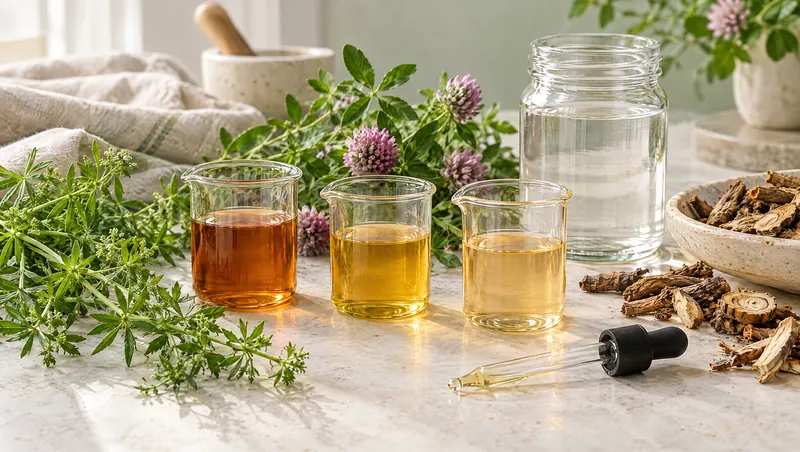
Drops are liquid herbal extracts, capsules hold powdered herb or dried extract in a shell, and tea is herb steeped in water at home. All three can start from the same plant.
The NIH’s Office of Dietary Supplements (ODS) notes that botanicals are sold as fresh or dried herb, liquid or solid extracts, tablets, capsules, powders and tea bags. It describes tea as herb steeped in boiling water, and explains that tougher materials such as roots, bark and berries are simmered longer to make a decoction. An extract is made by soaking a plant in a liquid such as water or alcohol, and some extracts are then dried to fill capsules or tablets.
That detail matters for lymphatic blends. Two classic herbs, stillingia root and prickly ash bark, are exactly the tough roots and bark that call for longer simmering than a quick cup gets. Liquid drops come in two main types: tinctures, made with alcohol and water, and glycerites like Cleavera, made with vegetable glycerin and water. Our glycerite vs. tincture guide covers that choice.
Which form gives the most consistent dose?
Capsules usually give the most consistent dose, liquid drops come close when you measure carefully, and tea varies the most.
- Capsules. Each one holds a set weight of herb or extract. The FDA’s 2007 manufacturing rule for supplements requires companies to set specifications for identity, purity, strength and composition, and you swallow the same amount every time.
- Drops. A liquid extract is made in batches to one recipe and measured by volume. The rest is up to you: shake gently and use the dropper’s 1 mL marking or a ¼ teaspoon measure rather than counting drops. Our guide to taking lymphatic drops explains why drop counts drift.
- Tea. Strength depends on how much herb you use, the water temperature and the steeping time. In a 2024 study published in Molecules, all three changed the mix of compounds in cold-water chamomile extracts. Two cups of the same tea can differ, and the box can’t tell you what reached your cup.
Consistency isn’t the same as quality, though. ODS notes that U.S. law doesn’t require botanical supplements to be standardized, so the word “standardized” on a label doesn’t guarantee much on its own. A consistent serving of a well-made product is the goal, whatever the form.
Do liquid drops absorb better than capsules?
Not as far as anyone has shown for these herbs. We looked for studies comparing how cleavers, red clover, stillingia or prickly ash are absorbed from drops, capsules or tea, and found none.
A liquid is already in solution, while a capsule has to break apart first. But that doesn’t tell you how much of a plant’s compounds your body takes up, or how quickly. That depends on the compounds themselves, what else is in your stomach and how the product was made. Claims that drops absorb several times faster, or that holding them under your tongue sends them straight into your bloodstream, aren’t backed by research on these herbs. If a brand makes that claim, ask to see the study.
Cleavera’s directions don’t ask you to hold the drops under your tongue. You simply stir 1 mL into a drink or take it straight, twice a day.
How do drops, capsules and tea compare on taste and convenience?
Capsules win on taste and speed, drops on flexibility, and tea on ritual.
Capsules take seconds, travel well and hide the taste entirely, but you need water and you need to swallow them. In a 2014 study in the Annals of Family Medicine, 55.6 percent of 151 German adults reported difficulty swallowing pills. The same researchers found a simple lean-forward technique made capsules easier to swallow for most people who tried it.
Drops take under a minute and mix into water, tea, juice or a smoothie, but you do taste the herbs. Glycerites are lightly sweet, while tinctures carry an alcohol bite. Cleavera tastes earthy, with a gentle warming tingle from prickly ash.
Tea is the slowest: 5 to 15 minutes for a hot cup, or overnight for a cold infusion, plus a kettle and a strainer. In return you get a calming ritual and a drink. The National Academies report that about 80 percent of the water people take in comes from drinking water and other beverages, so a cup of herbal tea counts. Our recipe for how to make cleavers tea shows the gentle, traditional approach.
How do you read the label on each form?
Read the Supplement Facts panel on drops and capsules, and the ingredient list and weight per bag on tea. The federal labeling rule for supplements, 21 CFR 101.36, shapes what you’ll see:
- Liquid extracts list the volume or weight of the total extract. The label must say if the starting herb was fresh, and may add the herb-to-solvent ratio and the solvent, such as alcohol.
- Capsules made with a dried extract list the weight of that dried extract; capsules of powdered herb list the herb’s weight.
- Every botanical must be listed with the part of the plant it came from.
- Proprietary blends show the blend’s total weight, with ingredients in descending order by weight, but not each herb’s amount.
- Teas may be sold as supplements with a Supplement Facts panel, or as ordinary foods with just an ingredient list. Check the grams per bag and whether each herb is named.
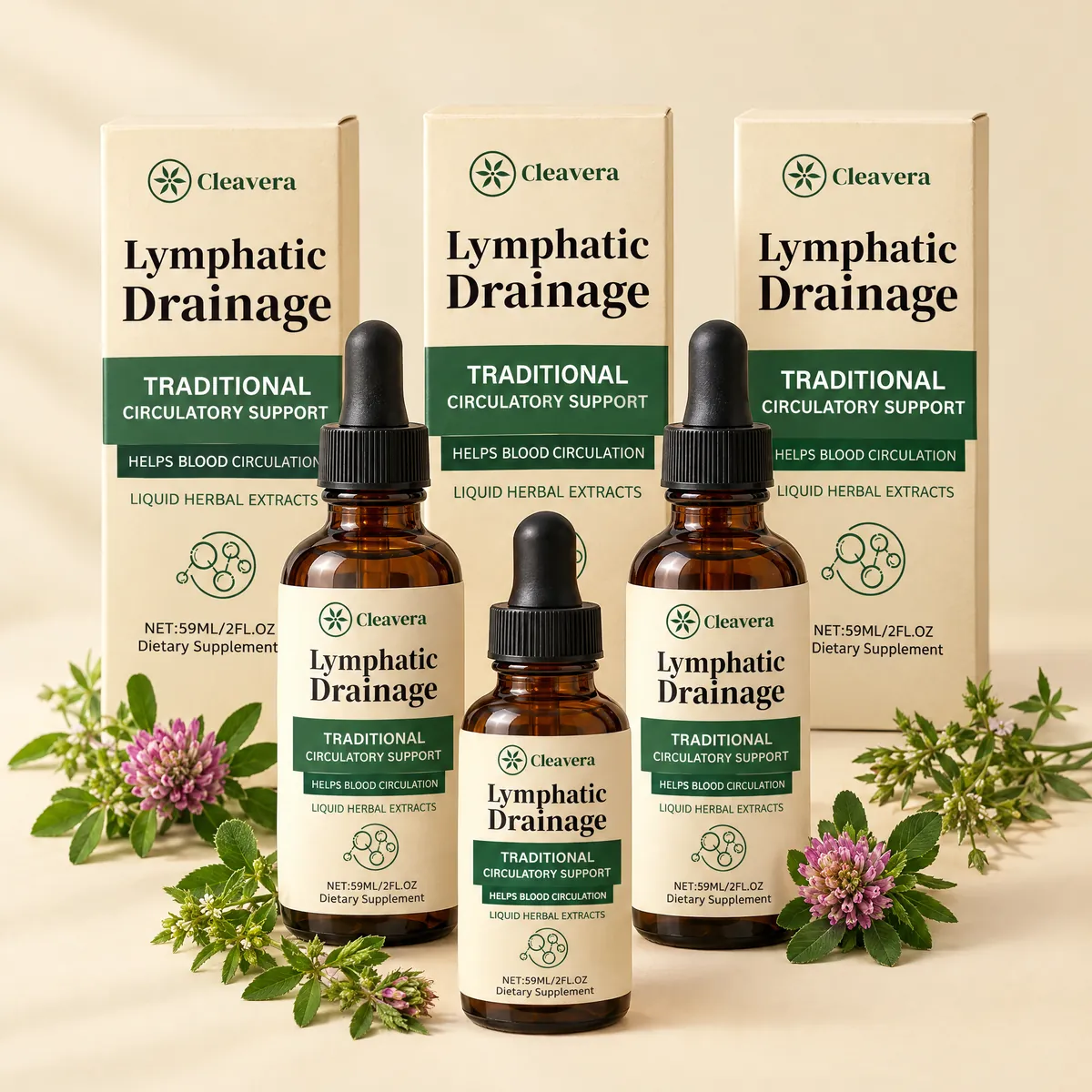
Cleavera’s panel, for example, lists a 300 mg proprietary blend per 1 mL serving of four named herbs and their plant parts, in vegetable glycerin and water. Compare forms by serving, not by bottle or box size. Our label-reading guide to choosing lymphatic drops goes further.
Lymphatic drops vs. capsules vs. tea at a glance
Here’s the side-by-side view of all three forms.
| Liquid drops | Capsules | Tea | |
|---|---|---|---|
| What it is | Herbs extracted in glycerin, alcohol or water, measured in mL | Powdered herb or dried extract in a shell | Herb steeped or simmered in water at home |
| Dose consistency | High, if measured with a marked dropper | Highest: a set weight per capsule | Varies with amount, temperature and time |
| Taste | You taste the herbs; glycerites are lightly sweet | Little or none | Depends on the herb, from mild to bitter |
| Time | Under a minute | Seconds, with water | 5 to 15 minutes, or overnight cold |
| Alcohol | Tinctures yes; glycerites no | Usually none | None |
| Label shows | Extract volume or weight; may add ratio and solvent | Weight of herb or dried extract | Often just ingredients and net weight |
| Good fit if | You want to add it to a drink you already have | You want no taste and a fixed amount | You enjoy a slow ritual and want the fluids |
| Watch-outs | Measure, don’t count drops; keep the dropper clean | Hard to swallow for some; check the shell and fillers | Hardest to dose consistently; roots and bark need longer simmering |
Which form is right for you?
Pick the form you’ll take consistently and safely, because herbal routines are built on steady use.
- Choose drops if you like folding a supplement into a drink you already have, want to measure by the milliliter, or avoid alcohol (look for a glycerite).
- Choose capsules if taste is a dealbreaker, you swallow pills easily and you want the simplest travel option. Check “Other ingredients” for the capsule shell and fillers.
- Choose tea if you enjoy the ritual, want caffeine-free fluids and don’t mind a less exact amount.
Don’t double up on the same herb across forms. Cleavers tea plus drops that contain cleavers adds up, so stay within each product’s label serving and tell your clinician about both.
We chose a liquid for Cleavera because it disappears into a glass of water or tea, can be measured to the milliliter and lets us leave out alcohol. Each serving combines cleavers, red clover, stillingia and prickly ash, herbs traditionally used to support healthy lymphatic flow.* See the full label on the Lymphatic Drainage Drops page, how a daily routine works on How It Works, and an honest look at the evidence in do lymphatic drainage drops work?
Does the form change who should avoid these herbs?
No. The form changes how you take an herb, not who should be careful with it.
Red clover is a good example. The NIH’s National Center for Complementary and Integrative Health (NCCIH) notes that red clover contains isoflavones, compounds structurally similar to estrogen, and that red clover supplements may be unsafe during pregnancy or breastfeeding. That holds in a capsule, a tincture or a cup. NCCIH also reminds consumers that the FDA doesn’t review supplements for safety and effectiveness before they’re sold, and that some supplements interact with medicines.
Whatever the form, Cleavera is for adults only. Talk to your healthcare professional before use if you’re pregnant or nursing, take medication (including blood thinners or hormone therapy), have a hormone-sensitive or bleeding condition, or have surgery scheduled. Don’t exceed the label serving, and stop use if you experience nausea or digestive upset. Our guide to lymphatic drops side effects and who should skip them covers each herb.
Frequently asked questions
Are capsules stronger than drops?
Not necessarily. Strength depends on how much herb or extract is in a serving and how it was made, not on the form. Compare Supplement Facts panels: milligrams per capsule against the extract amount per milliliter, plus any ratio. A proprietary blend shows only the total, so ask the brand if you need more detail.
Can you open a capsule and stir it into a drink?
Check the label first, or ask the brand or a pharmacist. Some capsules are designed to stay closed, and the powder inside may taste bitter or clump in liquid. If you want an herb in a drink, liquid extracts and teas are made for that, so it’s simpler to choose one of those forms instead.
Can you put lymphatic drops in hot tea?
Yes. Stir your serving into tea once it has cooled to a comfortable sipping temperature, as Cleavera’s directions suggest. There’s no published research on how heat affects these particular extracts, so a cooled cup is the simple, cautious choice, and it lets you drink your serving straight away.
Which form is easiest to travel with?
Capsules are the easiest, since they’re light, dry and hard to break. A 59 mL (2 fl oz) bottle of drops fits within the TSA’s 3.4-ounce limit for carry-on liquids, so pack it upright in a sealed bag. Tea is the bulkiest option and needs hot water and a strainer wherever you are.
Do herbal teas count as dietary supplements?
Sometimes. An herbal tea can be sold as a dietary supplement, with a Supplement Facts panel, or as an ordinary food, with an ingredient list. The herbs may be identical, but a supplement label usually tells you more about amounts per serving. Either way, look for each herb’s name, the plant part and the weight per bag.
Sources
- NIH Office of Dietary Supplements. “Botanical Dietary Supplements: Background Information.” ods.od.nih.gov/factsheets/BotanicalBackground-Consumer
- U.S. Food and Drug Administration, Federal Register (2007). “Current Good Manufacturing Practice in Manufacturing, Packaging, Labeling, or Holding Operations for Dietary Supplements; Final Rule.” govinfo.gov/content/pkg/FR-2007-06-25
- Legal Information Institute, Cornell Law School. “21 CFR § 101.36 – Nutrition labeling of dietary supplements.” law.cornell.edu/cfr/text/21/101.36
- Foschi et al., Molecules (2024), via PubMed Central. “Optimization of the Cold Water Extraction Method for High-Value Bioactive Compounds from Chamomile (Matricaria chamomilla L.) Flower Heads Through Chemometrics.” pmc.ncbi.nlm.nih.gov/articles/PMC11510547
- Schiele et al., Annals of Family Medicine (2014). “Two Techniques to Make Swallowing Pills Easier.” annfammed.org/content/12/6/550
- National Academies. “Report Sets Dietary Intake Levels for Water, Salt, and Potassium To Maintain Health and Reduce Chronic Disease Risk.” nationalacademies.org/news/report-sets-dietary-intake-levels…
- NIH National Center for Complementary and Integrative Health. “Red Clover.” nccih.nih.gov/health/red-clover
- NIH National Center for Complementary and Integrative Health. “Using Dietary Supplements Wisely.” nccih.nih.gov/health/using-dietary-supplements-wisely