Red Clover: Traditional Uses, Isoflavones & Who Should Avoid It
A meadow tea, a 19th-century herb and a modern isoflavone supplement: what red clover is, what studies have and haven’t found, and who should skip it.
Red clover is one of North America’s most familiar wildflowers. Look up red clover benefits and you’ll find two very different stories: a gentle meadow tea with generations of folk use, and a concentrated isoflavone supplement studied for menopause.
This guide covers both: the plant, its history, the research and the safety questions that matter most, including red clover with blood thinners and hormones. It’s general information, not medical advice.
What is red clover?
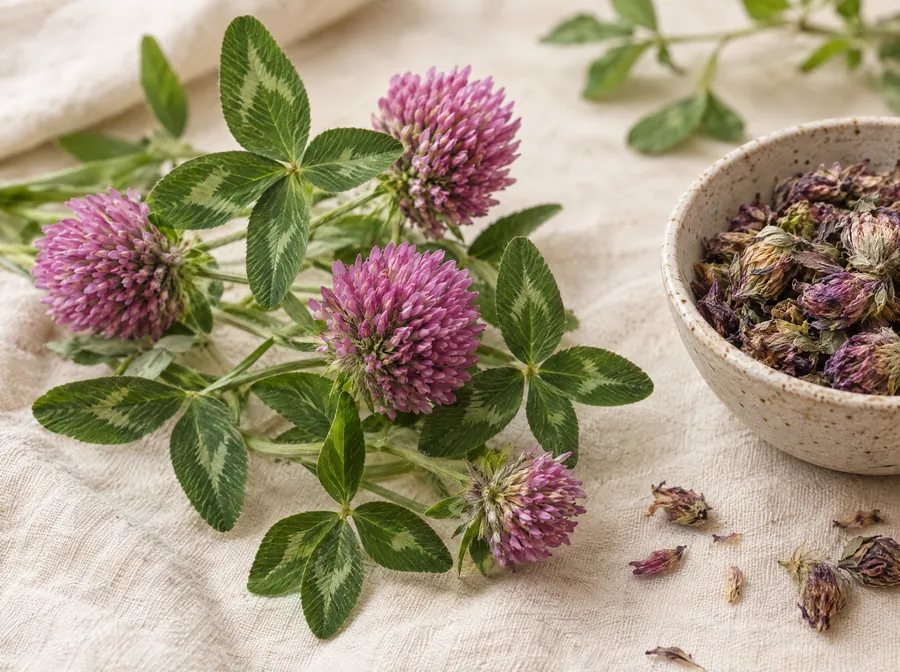
Red clover is a flowering legume, Trifolium pratense, in the pea family (Fabaceae), and its rose-pink flower heads are the part used in herbal tradition. The NIH’s National Center for Complementary and Integrative Health (NCCIH) describes it as native to Europe, central Asia and northern Africa.
It is also a working farm plant. According to a USDA Natural Resources Conservation Service plant guide, red clover is the most widely grown of all the true clovers and the most important legume hay crop in the northeastern United States. Like other legumes, it partners with Rhizobium bacteria in its roots to capture nitrogen from the air, so farmers sow it for hay, pasture and soil improvement. The guide traces its origins to Asia Minor and southeastern Europe; English colonists brought it to North America, and today it grows throughout the United States.
How do you recognize red clover?
Look for a low, leafy plant with three-part leaves, often marked with a pale V, and round, rose-pink to purple flower heads about an inch across. The USDA guide describes hollow, hairy stems and heads of up to 125 tiny pea-like flowers. Red clover lives as a biennial or short-lived perennial, and bumblebees are its most important pollinators.
| Feature | Details |
|---|---|
| Latin name | Trifolium pratense L. |
| Plant family | Fabaceae (pea or legume family) |
| Other names | Meadow clover, cow clover, wild clover, purple clover |
| Part used | Flower heads (blossoms) |
| Life cycle | Biennial or short-lived perennial |
| Native range | Europe, central Asia and northern Africa; introduced across North America |
| Best-known compounds | Isoflavones, including formononetin and biochanin A |
| Dried blossoms | Faintly aromatic and tea-like; sweetish, then slightly bitter |
| In Cleavera | Red clover flower extract, one of four botanicals |
How has red clover been used traditionally?
For generations, red clover blossoms were brewed as a simple tea, and by the late 1800s they were a regular part of American herbal practice. The 1898 King’s American Dispensatory, a standard Eclectic reference, names the blossoms as the part used and describes an infusion of one ounce of flowers to a pint of water.
Eclectic writers grouped red clover with the “alteratives,” a historical class of herbs taken steadily over time. Red clover also lent its name to a 19th-century proprietary blend, Trifolium Compound, and King’s notes that prickly ash was one of its ingredients. In 1916, red clover blossoms entered the fourth edition of the National Formulary, an official American drug standard.
Not everyone was convinced, even then. The 1918 United States Dispensatory remarked of clover: “There is, however, no sufficient reason to suspect it of any medicinal virtue.” Today, red clover flower is traditionally used to support the body’s natural cleansing processes.* For the wider story of red clover and its three companion herbs, read the herbal tradition behind cleavers, red clover, stillingia and prickly ash.
What are red clover isoflavones?
Isoflavones are plant compounds that are structurally similar to estrogen, and they are the main reason scientists study red clover. Because they can weakly act on estrogen receptors, isoflavones are also called phytoestrogens. Memorial Sloan Kettering’s About Herbs database names formononetin and biochanin A among red clover’s isoflavones.
Most clinical research hasn’t used the flowers as people traditionally did. Instead, it has tested concentrated extracts standardized to a set daily amount of isoflavones, such as the branded extract Promensil.
What are the benefits of red clover, according to research?
No benefit of red clover is firmly established. NCCIH says research hasn’t shown conclusive evidence that red clover helps with any health condition, and most studies have focused on menopausal hot flashes, with mixed results.
A 2013 Cochrane review of 43 randomized trials of phytoestrogens pooled five trials of the red clover extract Promensil and found no significant difference in daily hot flashes compared with placebo. It also noted a strong placebo effect, with hot flashes falling by anywhere from 1% to 59% in placebo groups. A 2021 meta-analysis of eight trials reached a somewhat different result: about 1.7 fewer hot flashes a day with red clover than with placebo, with clearer differences at isoflavone doses of 80 mg a day or more. Its authors still called for better-designed studies.
| What was studied | What research found |
|---|---|
| Menopausal hot flashes | Mixed. Pooled Promensil trials showed no significant difference from placebo (Cochrane, 2013); a 2021 meta-analysis found a modest reduction |
| Cholesterol after menopause | Possible benefit, but NCCIH says more research is needed |
| Bone density after menopause | Only a few studies, with inconsistent results (NCCIH) |
| Red clover tea | We found no clinical trials |
| Lymphatic flow | We found no clinical trials |
These results apply to specific extracts at specific doses. They don’t tell you what a cup of tea, or a small amount of red clover flower in a multi-herb blend, will do. We take a broader look at this kind of evidence in Do Lymphatic Drainage Drops Work? An Honest Look at the Evidence.
Is red clover tea the same as a red clover supplement?
No. Red clover tea is a traditional infusion of dried blossoms, while most red clover supplements in studies are concentrated isoflavone extracts, and the two can differ greatly in strength. Neither one is automatically safer.
The NIH’s Office of Dietary Supplements puts it simply: the same amount of a botanical may be found in a cup of tea, a few teaspoons of tincture or an even smaller amount of extract, and each preparation draws out different amounts of the plant’s constituents. U.S. law doesn’t require botanical supplements to be standardized, and a homemade tea has no stated isoflavone content at all. The safety cautions below apply to tea, too.
Is red clover safe?
Red clover appears well tolerated by most healthy adults in studies, but it isn’t right for everyone. According to NCCIH, red clover extracts were used in clinical studies lasting up to two years with apparent safety and good tolerability. The Cochrane review of phytoestrogen supplements, red clover extracts among them, likewise found no evidence that they stimulated the uterine lining or caused other adverse effects over up to two years.
Rare problems have been reported, though. Memorial Sloan Kettering’s professional notes describe two case reports of bleeding around the brain in women using red clover products. Case reports can’t prove cause, but they help explain the caution around blood thinners.
Red clover with blood thinners and other medicines
Memorial Sloan Kettering warns that red clover may increase the effects of anticoagulant and antiplatelet drugs, such as warfarin, though the clinical importance isn’t yet known. Lab studies also suggest it may inhibit several liver enzymes that process common medicines. MSK further notes a reported case of toxicity in a person receiving methotrexate injections who also used red clover. If you take any prescription medicine, ask your pharmacist before adding red clover in any form.
Red clover and hormones
Because isoflavones have estrogen-like activity, NCCIH says red clover supplements may be unsafe during pregnancy or breastfeeding, and Memorial Sloan Kettering advises against them for people with certain hormone-sensitive conditions.
Who should avoid red clover?
Skip red clover, or talk to your clinician before using it, if any of these apply to you:
- You’re pregnant, trying to conceive or breastfeeding.
- You’re under 18.
- You have a current or past hormone-sensitive condition, such as some breast or uterine conditions, endometriosis or fibroids.
- You take hormone therapy or hormonal birth control.
- You take blood thinners or antiplatelet medicines, or have a bleeding disorder.
- You take methotrexate.
- You have surgery or a dental procedure coming up.
- You’ve reacted to red clover or other clovers before.
Our guide to lymphatic drainage drops side effects and who should skip them covers the other herbs in our formula, and lymphatic drops during pregnancy and breastfeeding explains why Cleavera isn’t for those times.
Bring the label to your clinician before using any red clover product if you’re pregnant or nursing, have a hormone-sensitive or bleeding condition, take prescription medicines, or have surgery scheduled.
Stop and get advice if you notice unusual bruising or bleeding, a rash, or digestive upset. Seek emergency care for trouble breathing or swelling of the lips, tongue or throat.
How does red clover appear in Cleavera?
Cleavera uses red clover flower, extracted in vegetable glycerin and water, as one of four botanicals in a 300 mg proprietary blend in every 1 mL serving. We use the flower heads only, the part named in traditional references.
Red clover flower is traditionally used to support the body’s natural cleansing processes.* Alongside cleavers, stillingia root and prickly ash bark, it’s part of a formula traditionally used to support healthy lymphatic flow.* Like most multi-herb extracts, the label lists the blend total rather than each herb’s amount, and it doesn’t state an isoflavone content. Cleavera hasn’t been studied for menopausal symptoms or any other condition, and we don’t sell it for them.
See the full Supplement Facts on the Lymphatic Drainage Drops page, meet all four plants on our ingredients page, or read about red clover’s partners in our stillingia root guide and our prickly ash bark guide.
Frequently asked questions
Does red clover contain estrogen?
No. Red clover contains isoflavones, plant compounds that are structurally similar to estrogen and can weakly act on the body’s estrogen receptors. They aren’t the same as the estrogen your body makes, but that activity is why people who are pregnant or hormone-sensitive should talk to a clinician first.
Is red clover the same as white clover or sweet clover?
No. White clover (Trifolium repens) is a related species with smaller white flower heads that creeps through lawns. Sweet clovers belong to a different genus, Melilotus, and grow as taller plants with slender spikes of small yellow or white flowers. This guide’s research and safety notes apply to red clover only.
Can you pick and dry your own red clover blossoms?
Only if you’re certain of the plant and the site. Skip roadsides, lawns and fields that may have been sprayed, choose fresh, fully open pink heads, and dry them in a shady, airy spot. Homemade tea isn’t standardized, so the same pregnancy, hormone and blood-thinner cautions apply.
What does red clover tea taste like?
Mild. The 1918 United States Dispensatory described dried red clover blossoms as faintly aromatic and somewhat tea-like, with a taste that is sweetish at first and then slightly bitter. On its own it tastes gentle and a little grassy, and it blends easily with other herbal teas.
Should you stop red clover before surgery?
Tell your surgeon, anesthesiologist and dentist that you take it, and follow their instructions on when to stop and restart. Because red clover may add to the effect of blood thinners, surgical teams commonly ask patients to pause herbal supplements, including teas and drops, ahead of a procedure.
Sources
- NIH National Center for Complementary and Integrative Health. “Red Clover: Usefulness and Safety.” nccih.nih.gov/health/red-clover
- Memorial Sloan Kettering, About Herbs. “Red Clover.” mskcc.org/…/herbs/red-clover
- NIH Office of Dietary Supplements. “Botanical Dietary Supplements: Background Information.” ods.od.nih.gov/factsheets/BotanicalBackground-Consumer
- Lethaby, A., et al. Cochrane Database of Systematic Reviews (2013). “Phytoestrogens for menopausal vasomotor symptoms.” pubmed.ncbi.nlm.nih.gov/24323914
- Kanadys, W., et al. Nutrients (2021). “Evaluation of Clinical Meaningfulness of Red Clover (Trifolium pratense L.) Extract to Relieve Hot Flushes and Menopausal Symptoms in Peri- and Post-Menopausal Women.” pubmed.ncbi.nlm.nih.gov/33920485
- USDA Natural Resources Conservation Service. “Plant Guide: Red Clover, Trifolium pratense L.” plants.usda.gov/…/pg_trpr2.pdf
- Felter, H. W. & Lloyd, J. U. King’s American Dispensatory (1898), via Henriette’s Herbal Homepage. “Trifolium.—Red Clover.” henriettes-herb.com/eclectic/kings/trifolium-prat
- Remington, J. P., Wood, H. C., et al. The Dispensatory of the United States of America (1918), via Henriette’s Herbal Homepage. “Trifolium. Red Clover.” henriettes-herb.com/eclectic/usdisp/trifolium