How to Identify Cleavers (Galium aparine), the Sticky Hedgerow Herb
The plant that clings to your sleeve on a spring walk is one of the easiest wild herbs to recognize, once you know what to look and feel for. Here’s how to identify cleavers, rule out its look-alikes and forage with care.
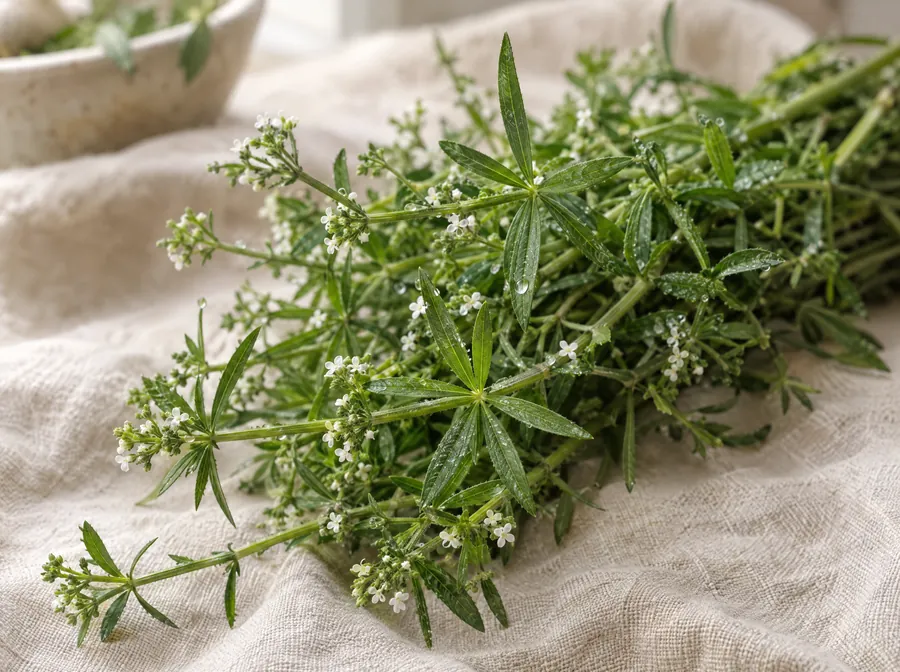
If you’ve walked past a hedge in spring and found green sprigs stuck to your jeans, you’ve probably met cleavers already. It’s one of the most common wild plants in gardens and field edges across much of the Northern Hemisphere, and it happens to be the hedgerow herb that gave Cleavera its name.
This guide covers how to identify cleavers step by step, when and where it grows, the look-alikes to rule out, and how to forage safely and respectfully. For the plant’s folklore and its place in Western herbal history, see The Herbal Tradition Behind Cleavers, Red Clover, Stillingia & Prickly Ash.
What is cleavers?
Cleavers is Galium aparine, a fast-growing annual in the madder family (Rubiaceae) that scrambles over other plants using tiny hooked hairs. The USDA PLANTS Database classifies it as both an herb and a vine and lists its common name as stickywilly.
Its many folk names all describe that grip: goosegrass, sticky willy, stickyweed, catchweed bedstraw and clivers. The USDA lists it as native to the lower 48 states, Alaska and Canada, and the Royal Horticultural Society describes it as an annual wildflower native to the UK.
Cleavers belongs to Galium, the bedstraw genus, whose members share square stems and leaves arranged in rings. Several look alike at a glance, and only one is famously sticky.
How do you identify cleavers?
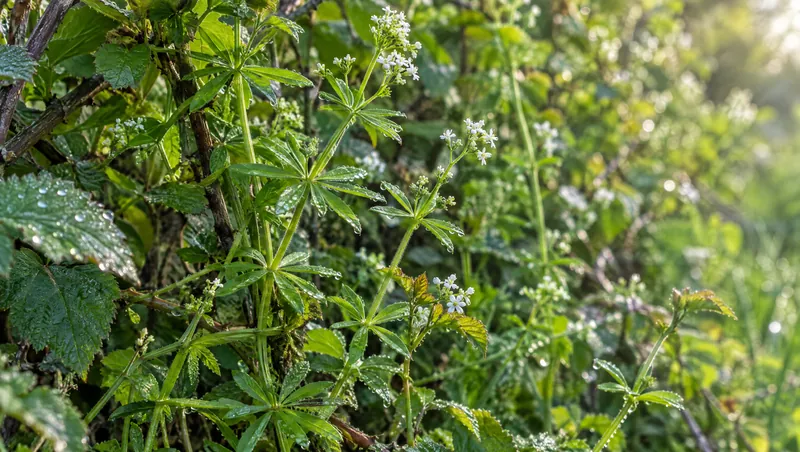
Start with touch: cleavers sticks to you. Then confirm it with four features: a square stem with tiny downward-pointing prickles, whorls of six to eight narrow leaves, tiny white four-petaled flowers, and round burs that grow in pairs.
- Do the stick test. Brush a sprig against your sleeve. Penn State Extension describes hook-like hairs on the stems, leaves and seed pods “that stick to almost everything they touch.” If a plant doesn’t cling at all, it probably isn’t cleavers.
- Roll the stem between your fingers. It’s square, with four distinct edges. According to the University of California’s IPM program, the stems are weak, often unbranched and armed with tiny down-curved prickles you can see with a hand lens. Too weak to stand alone, they sprawl and climb, often reaching up to about 1 meter (3 feet) long.
- Count the leaves. Narrow leaves grow in whorls, or rings, of six to eight around the stem. UC IPM gives their length as 14 to 35 mm (roughly ½ to 1⅜ inches), with a small bristle at each tip and curved prickles along the edges and midrib that give them a raspy feel. Young plants may show only four leaves per whorl.
- Look closely for flowers. In spring and early summer, tiny white to greenish flowers with four pointed petals appear on slender stalks that rise from where the leaves meet the stem. Minnesota Wildflowers puts them at about 1/16 inch across, in small clusters of two to five. You may need to crouch down to see them.
- Find the burs. The fruits come in pairs: two small, round lobes joined together, 2 to 5 mm wide according to UC IPM, and covered in hook-tipped bristles. The RHS describes them as green or purple when young. They ripen brown and split into two seeds.
- Check the roots. Cleavers has shallow, fibrous roots, so young plants pull up easily, roots and all.
When does cleavers grow and flower?
Cleavers is a cool-season annual. It sprouts in early spring and again in late summer to early fall, flowers from spring into early summer, sets seed and then dies back. Spring, when plants are lush and flowering, is the easiest time to identify it.
Flowering time shifts with climate. UC IPM lists March through July in California, Penn State Extension reports late May to mid-June in Pennsylvania, Minnesota Wildflowers gives May to June, and the RHS notes May to August in the UK. In mild areas, plants that sprout in fall can overwinter as small seedlings, which is why UC IPM describes cleavers as a winter or summer annual.
Seedlings are worth learning too. UC IPM describes the first seed leaves as oblong to egg-shaped with slightly notched tips, followed by a first ring of four true leaves on a square stem. By midsummer, many plants have turned into tangles of brown burs. Penn State notes a single mature plant can produce 300 or more seeds, which stay viable for a couple of years.
Where does cleavers grow?
Look in moist, fertile, partly shaded places: hedgerows, woodland edges, thickets, garden beds and fence lines. Cleavers also turns up in orchards, crop fields and other disturbed ground.
Minnesota Wildflowers lists part shade to shade in moist woods and thickets. Penn State Extension adds that it prefers moist, fertile soil and tolerates sun, and that in home gardens it’s most common in landscape beds and along wooded edges. UC IPM notes that it usually needs some disturbance, such as dug or cleared soil, to get established.
It also travels well. The RHS explains that seeds hitch rides on clothing, pet fur and passers-by, and that gardens bordering farmland or wasteland often see it creep in through boundary hedges.
What plants look like cleavers?
Other bedstraws are the main look-alikes. Sweet woodruff, lady’s bedstraw and smooth bedstraw all have square stems and whorled leaves, but none has cleavers’ clinging stems and leaves. Lady’s bedstraw is the easiest to rule out once it blooms, because its flowers are yellow.
| Plant | Life cycle | Leaves per whorl | Flowers | Feel | Usual setting |
|---|---|---|---|---|---|
| Cleavers (Galium aparine) | Annual | 6–8, narrow, bristle-tipped | Tiny, white to greenish, few per cluster | Clings to clothing; raspy stems and leaves | Shady hedgerows, wood edges, garden beds |
| Sweet woodruff (G. odoratum) | Perennial | 6–8 (up to 9), lance-shaped | Small, white, star-shaped, in spring | Smooth, hairless leaves; low carpet 6–12 inches tall | Shady gardens, as ground cover |
| Lady’s bedstraw (G. verum) | Perennial | 8–12, very narrow | Yellow, in many-flowered branching clusters, June–August | Finely hairy, not clingy | Sunny roadsides and fields |
| Smooth bedstraw (G. mollugo) | Perennial, spreads by underground stems | Similar to cleavers | Small, white | No bristles on leaves, stems or seed pods | Fields and pastures |
Sweet woodruff
Sweet woodruff is the look-alike most people have in their own gardens. NC State Extension describes it as a low perennial ground cover with smooth, dark green leaves in whorls of six to eight and small white flowers in spring. Its crushed, dried leaves smell like freshly mowed hay. Its fruits are bristly, too, so judge it by the smooth leaves and carpet-like habit rather than the burs. NC State also notes that the flowers can have a blood-thinning effect if eaten in large amounts, one more reason never to swap one bedstraw for another.
Smooth and rough bedstraw
Penn State Extension notes that smooth bedstraw has the same overall structure as cleavers but lacks its bristles on the leaves, stems and seed pods, and spreads by underground runners. Rough bedstraw (G. asprellum) is named for its rough stems, but Minnesota Wildflowers notes it is much more branched, with shorter leaves mostly in whorls of four to six, smooth fruit and a preference for wet places.
Is it safe to forage cleavers?
Cleavers has a history as a spring green, but foraging any wild plant is only safe when you’re 100 percent certain of its identity, you pick from clean ground, and you start with a small amount.
- Be certain. Mississippi State University Extension advises being 100 percent sure a plant is correctly identified and not poisonous, and checking it against at least three different plant guides. Its rule of thumb is worth memorizing: when in doubt, leave it out.
- Choose clean ground. Skip roadsides, power line corridors, industrial areas and anywhere herbicides or pesticides may have been sprayed. Cleavers loves field edges and garden beds, so ask how the ground has been managed.
- Pick young growth. Mississippi State lists only the young, tender leaves and stems of cleavers for salads and greens.
- Wear gloves if your skin is sensitive. Penn State notes that the scratchy hairs can irritate people with sensitive skin.
- Go slowly. Rinse what you gather well, and eat any wild plant in moderation, starting with a small taste.
- Check your health first. If you’re pregnant or nursing, take medication or have a health condition, ask your clinician before eating or using foraged plants.
How do you forage cleavers ethically?
Ask permission, take a little, and leave plenty behind. Mississippi State Extension recommends taking no more than a third of any plant or plant population in one place, and always getting permission on private land.
Public land has its own rules. Most parks and wildlife refuges either don’t allow foraging or require a permit, so check before you pick. Leave no trace by carrying out what you bring.
Cleavers is rarely scarce, but it does feed other creatures. The RHS notes it’s a food plant for the caterpillars of moths such as the barred straw and the hummingbird hawk-moth, and suggests leaving some in a wild corner or at the base of a hedge. Before you head home, pick the burs off your socks and your dog’s coat so you don’t seed the next garden down the road.
How does cleavers relate to Cleavera?
Cleavers is the herb behind our name and the first botanical on our label. We use its aerial parts, the leafy stems, flowers and tops, extracted in vegetable glycerin and water alongside red clover, stillingia and prickly ash. In Western herbal tradition, cleavers is one of the classic plants traditionally used to support healthy lymphatic flow,* though modern clinical research on it is limited.
Gathering a few spring greens is one thing; making concentrated herbal preparations at home is another, because identity, strength and contamination are hard to control in a kitchen. You can read about each plant in Cleavera in our ingredient guide, why we chose an alcohol-free extract in Glycerite vs. Tincture, or see the full Supplement Facts on the Lymphatic Drainage Drops page. For the everyday habits that matter most, from walking to breathing, see 10 daily habits for healthy lymph flow.
Identification is the first safety step, not the last. Never eat or use a wild plant unless you’re certain of its identity, and skip anything gathered from roadsides or ground that may have been sprayed. If you’re pregnant or nursing, take medication (including blood thinners or hormone therapy), have a hormone-sensitive or bleeding condition, or have surgery scheduled, talk to your healthcare professional before using any herbal product, foraged or bought. Cleavera is for adults. Our guide to side effects and who should skip lymphatic drops covers the details.
Frequently asked questions
Why does cleavers stick to clothes?
Cleavers is covered in tiny hooked hairs and down-curved prickles on its stems, leaves and fruits. They help the weak stems climb over other plants, and they let the burs latch onto passing animals and people. That’s how the seeds travel to new ground, which is why you often find cleavers along paths and hedges.
Is cleavers a weed?
In gardens and farm fields, it usually is. UC IPM and Penn State Extension both describe it as a weed that scrambles over other plants and spreads seed readily. The RHS recommends pulling or hoeing seedlings before they flower and says weedkiller isn’t needed. Because it feeds moth caterpillars, some gardeners leave a patch in a wild corner.
Does cleavers come back every year?
Each plant lives for only one season, but cleavers reseeds generously. Penn State Extension reports that a mature plant can make 300 or more seeds, which remain viable for a couple of years and sprout in both spring and late summer to fall. So a patch tends to reappear in the same spot unless plants are pulled before they set seed.
Can you eat cleavers?
Historically, yes. Penn State Extension notes that the young leaves were eaten raw and cooked, and Mississippi State Extension lists the young, tender leaves and stems for salads and greens. Only eat cleavers if you’re completely sure of its identity and it grew on clean, unsprayed ground, and start with a small amount.
Is cleavers the same as bedstraw?
Cleavers is one kind of bedstraw. “Bedstraw” is the common name for plants in the genus Galium, and cleavers is often called catchweed bedstraw. When people say bedstraw on its own, they may mean lady’s bedstraw, smooth bedstraw or another species, none of which clings to clothing the way cleavers does.
Sources
- USDA Natural Resources Conservation Service, PLANTS Database. “Galium aparine L., stickywilly.” plants.usda.gov/plant-profile/GAAP2
- University of California Statewide IPM Program. “Catchweed Bedstraw.” ipm.ucanr.edu/PMG/WEEDS/catchweed_bedstraw
- Penn State Extension. “Getting the Best of Catchweed Bedstraw.” extension.psu.edu/getting-the-best-of-catchweed-bedstraw
- Minnesota Wildflowers. “Galium aparine (Sticky-willy).” minnesotawildflowers.info/flower/sticky-willy
- Minnesota Wildflowers. “Galium verum (Yellow Bedstraw).” minnesotawildflowers.info/flower/yellow-bedstraw
- Royal Horticultural Society. “Cleavers.” rhs.org.uk/weeds/cleavers
- NC State Extension Gardener Plant Toolbox. “Galium odoratum.” plants.ces.ncsu.edu/plants/galium-odoratum
- Mississippi State University Extension. “Forgotten Foods: Introduction to Wild Edible Plants.” extension.msstate.edu/publications/forgotten-foods-introduction-wild-edible-plants