Our ingredients, plant by plant.
Four traditional botanicals, each named by its Latin name and the exact part of the plant we use — extracted in vegetable glycerin and water, with nothing else added. Here’s everything that goes into Cleavera Lymphatic Drainage Drops, and why.
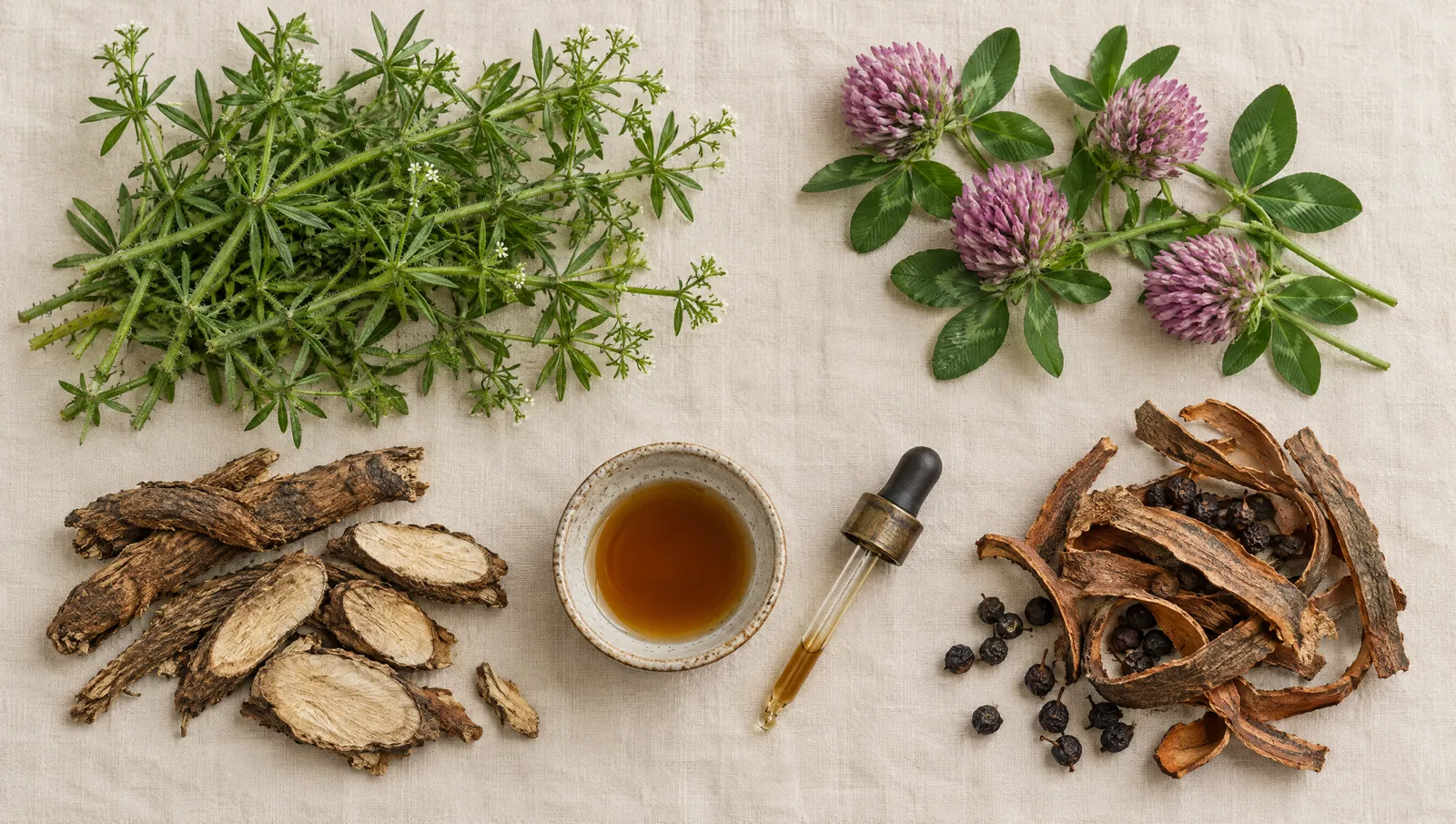
Four plants, chosen for their history
Cleavers, red clover, stillingia and prickly ash each have a long record in traditional Western herbalism, and herbalists have often combined them in formulas associated with the lymphatic system. Cleavera brings the four together in one alcohol-free liquid extract.
Instead of the alcohol used in most tinctures, the herbs are extracted in vegetable glycerin and water. The result is a mild, naturally sweet liquid with a 300 mg proprietary blend in every 1 mL serving — and an ingredient list short enough to read in one breath.
Below, you’ll find what each plant is, where it grows, how it was used historically, how it appears in our formula and anything worth knowing before you take it. For the bigger picture, see how it works.
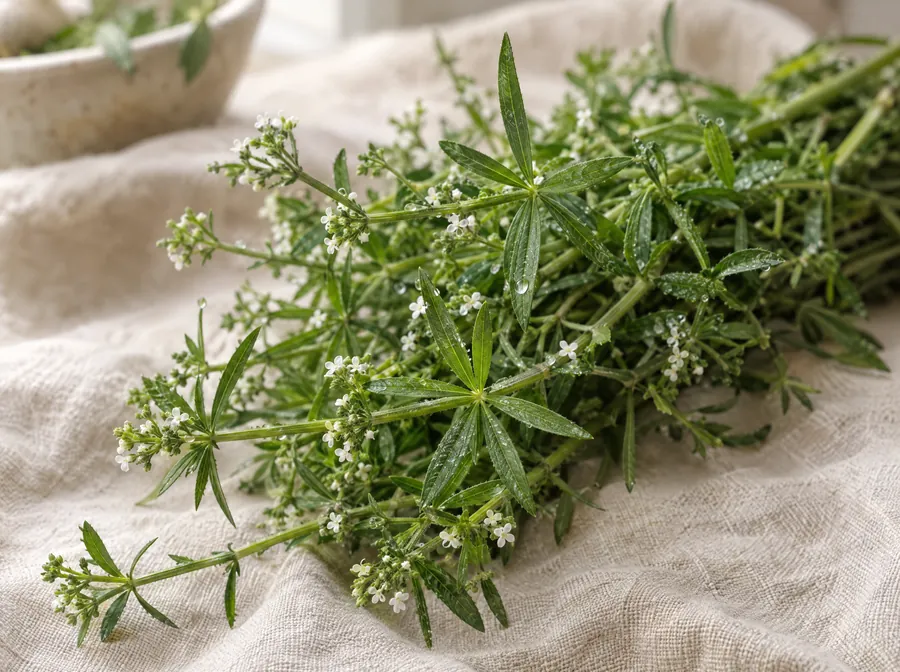
Cleavers, Galium aparine
If you’ve ever pulled a green sprig off your sleeve after a country walk, it was probably cleavers. This scrambling annual is covered in tiny hooked hairs that let it cling to hedges, fences, fur and clothing — which is exactly how it got its name.
Cleavers grows wild across Europe, North Africa, much of Asia and North America. Look for it in spring along hedgerows, woodland edges, stream banks and garden borders, where its square stems carry neat rings of six to eight narrow leaves and tiny white, star-like flowers.
Cleavers is traditionally used to support healthy lymphatic flow.*
Traditional use
Cleavers has been part of European folk practice for centuries, often prepared as a fresh spring tea or juice. In 19th-century America, Eclectic physicians — doctors who relied heavily on native and botanical remedies — described it in references such as King’s American Dispensatory, and herbalists came to regard it as one of the classic “lymphatic” herbs.
In our formula
We use the aerial parts — the leafy stems, flowers and tops that grow above ground — extracted in vegetable glycerin and water. Cleavers extract is the first botanical on our label, and the herb that gave Cleavera its name.
Good to know
Cleavers has a long history as a food plant as well as an herb: its young shoots were once cooked as a spring green. As with any supplement, check with your healthcare professional first if you’re pregnant, nursing or taking medication.
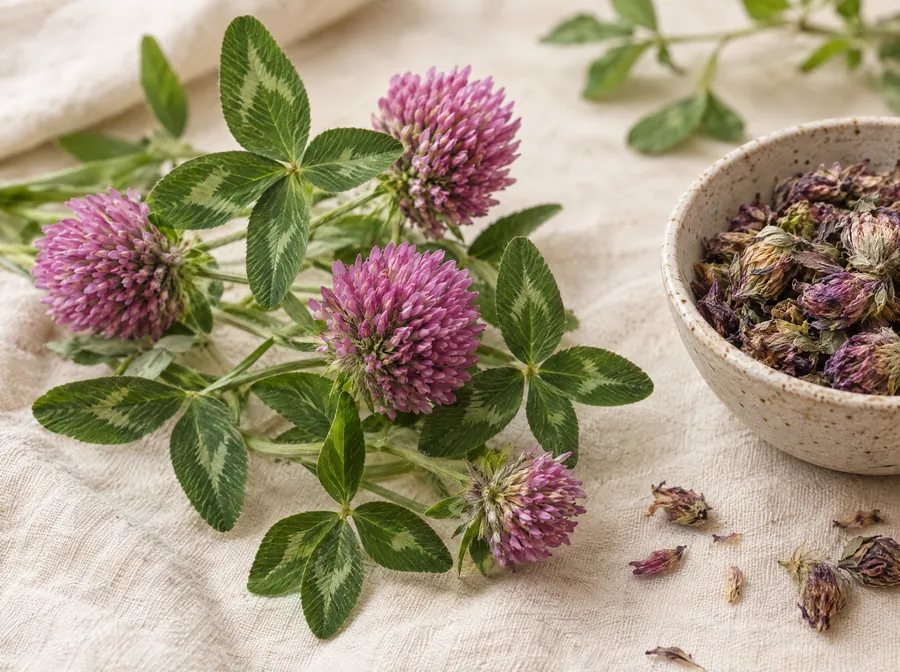
Red clover, Trifolium pratense
The rosy, globe-shaped blossoms of red clover are a familiar sight in summer meadows, pastures and roadsides. Each flower head is made of dozens of tiny tubular florets, sitting above three-part leaves that often carry a pale, V-shaped mark.
Native to Europe, western Asia and northwest Africa, red clover has naturalized throughout North America. As a member of the pea family it adds nitrogen to the soil, which is why farmers have long sown it as forage and as a cover crop. It is also the state flower of Vermont.
Red clover is traditionally used to support the body’s natural cleansing processes.*
Traditional use
Red clover blossoms were a staple of 19th-century American herbalism, usually prepared as teas and syrups. King’s American Dispensatory and other Eclectic texts describe the flowers, and herbalists traditionally grouped red clover with the “alteratives” — a historical category of gentle herbs taken over longer periods.
In our formula
We use the flower heads only — the part named in traditional references — extracted in vegetable glycerin and water. Red clover extract is the second of the four botanicals in our 300 mg blend.
Good to know
Red clover naturally contains isoflavones, plant compounds with mild estrogen-like activity. Talk to your healthcare professional before use if you’re pregnant or nursing, have a hormone-sensitive condition, use hormone therapy or hormonal birth control, take blood thinners or have surgery scheduled.
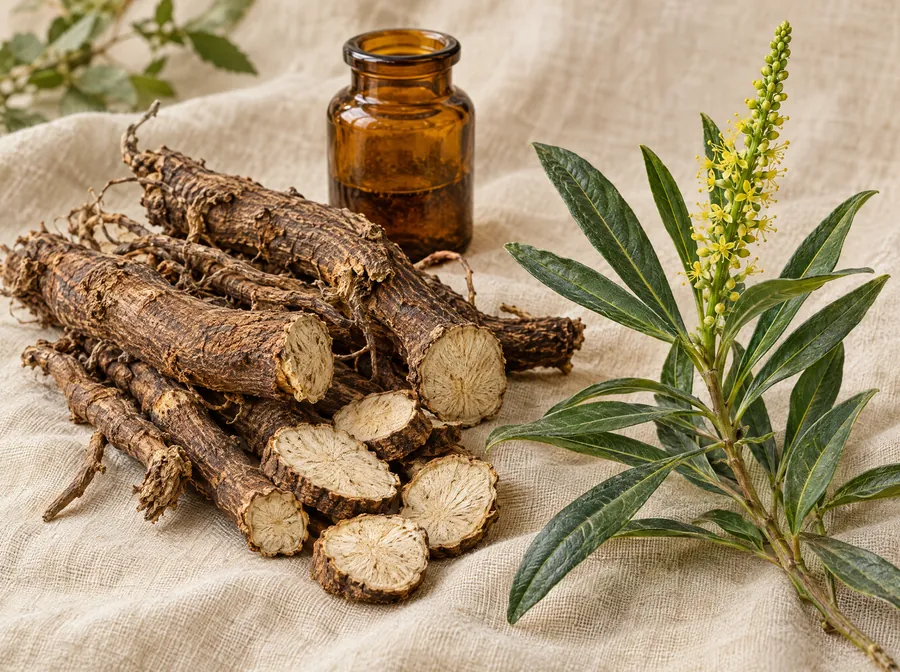
Stillingia root, Stillingia sylvatica
Stillingia is a perennial wildflower of the American South, known for generations as queen’s root or queen’s delight. Above ground it sends up slender spikes of small yellow flowers; below ground it grows a thick, woody root — the part herbalists value.
It thrives in sandy soil and open, sunny places: pine barrens, dry woodland clearings and coastal plains from Virginia to Florida and west into Texas. Like many members of the spurge family, the plant carries a milky sap.
Stillingia root is traditionally included in herbal blends to support the body’s natural cleansing processes.*
Traditional use
Stillingia root was well known to 19th-century American doctors. King’s American Dispensatory and other Eclectic references describe it at length, and it was a regular ingredient in the compound herbal syrups of the era. Practitioners generally preferred recently dried root and nearly always combined it with other herbs rather than giving it alone.
In our formula
We use the root, extracted in vegetable glycerin and water, as one of four botanicals in our 300 mg blend — the way it has traditionally been used: alongside other herbs, never as a standalone extract.
Good to know
Stillingia is a potent root, and tradition has always used it in small amounts. Larger amounts can cause nausea or digestive upset, so never exceed the suggested serving, and stop use if your stomach disagrees. Not for use during pregnancy or while nursing.
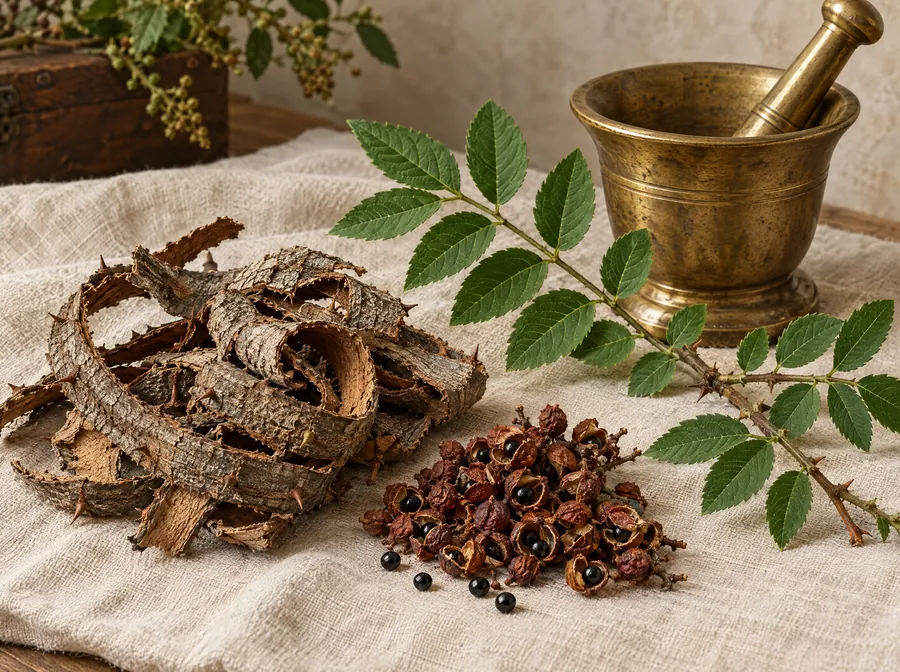
Prickly ash bark, Zanthoxylum americanum
Prickly ash is a thorny shrub or small tree native to eastern and central North America, where it forms dense thickets along woodland edges, riverbanks and rocky hillsides. Paired spines guard each leaf, and the crushed leaves give off a bright, lemony scent — a clue to its place in the citrus family.
In late summer it bears clusters of small reddish husks that split to reveal glossy black seeds. Its Asian relatives give Sichuan pepper its famous tingle, and prickly ash bark shares some of that warming, tingling character.
Prickly ash bark is traditionally used to support healthy circulation.*
Traditional use
Several Indigenous nations of North America used prickly ash, and the folk name “toothache tree” comes from the old practice of chewing the bark, which leaves the mouth tingling. Eclectic and Physiomedical practitioners of the 1800s valued it as a warming herb and often added it to formulas alongside other botanicals.
In our formula
We use the bark, extracted in vegetable glycerin and water. Prickly ash bark is the fourth botanical in the blend and the source of the gentle warming note you may notice when you take Cleavera.
Good to know
Prickly ash is traditionally avoided during pregnancy and while nursing. If you take blood thinners, have a bleeding condition or have surgery scheduled, check with your healthcare professional before use.
What’s not in the bottle
A short label is a deliberate choice. Besides the four herbs, there are only two other ingredients — vegetable glycerin and water. Here’s what we leave out.
No alcohol
The herbs are extracted in vegetable glycerin and water instead of ethanol — no burn, no bite, nothing to evaporate off.
No artificial colors or flavors
The amber color and earthy taste come from the herbs themselves, not from anything added to make them look or taste different.
No added sugar
The gentle sweetness comes from vegetable glycerin, not from added sugar or artificial sweeteners.
No gluten
A gluten-free formula, as printed on every box — easy to fit into a gluten-free routine.
No animal ingredients
Herbs, plant-derived glycerin and water. The formula is fully vegan.
No GMOs
Made with non-GMO ingredients, so you know exactly what kind of plants went into the bottle.
Supplement Facts, exactly as on the box
Nothing hidden and nothing vague. This is the same panel printed on every Cleavera carton.
The label lists all four botanicals by plant part and Latin name, along with the total amount of the blend in each serving: 300 mg. As with most multi-herb extracts, the individual amounts within the proprietary blend are not listed separately.
You’ll also see an asterisk in the % Daily Value column. That simply means no Daily Value has been established for herbal extracts — it’s standard for botanical supplements. Each 59 mL bottle holds 59 servings, or about 30 days at the suggested 1 mL twice daily.
Supplement Facts
Serving Size 1/4 teaspoon (1mL)
Servings Per Container 59
Extracts of:
- Cleavers aerial parts (Galium aparine)
- Red Clover flower (Trifolium pratense)
- Stillingia root (Stillingia sylvatica)
- Prickly Ash bark (Zanthoxylum americanum)
* Daily Value not established.
Other ingredients: vegetable glycerin, water.
More on the formula
How It Works
Your lymphatic system in plain language, plus exactly how to take the drops.
Explore →Glycerite vs Tincture
Why we extract in glycerin and water instead of alcohol.
Read →How to Identify Cleavers
Whorled leaves, hooked hairs and sticky stems: how to know the hedgerow herb.
Explore →Quality Standards
How Cleavera is sourced, extracted and third-party tested.
Explore →How to Choose Lymphatic Drops
A label-reading guide: Latin names, plant parts, blends and testing.
Explore →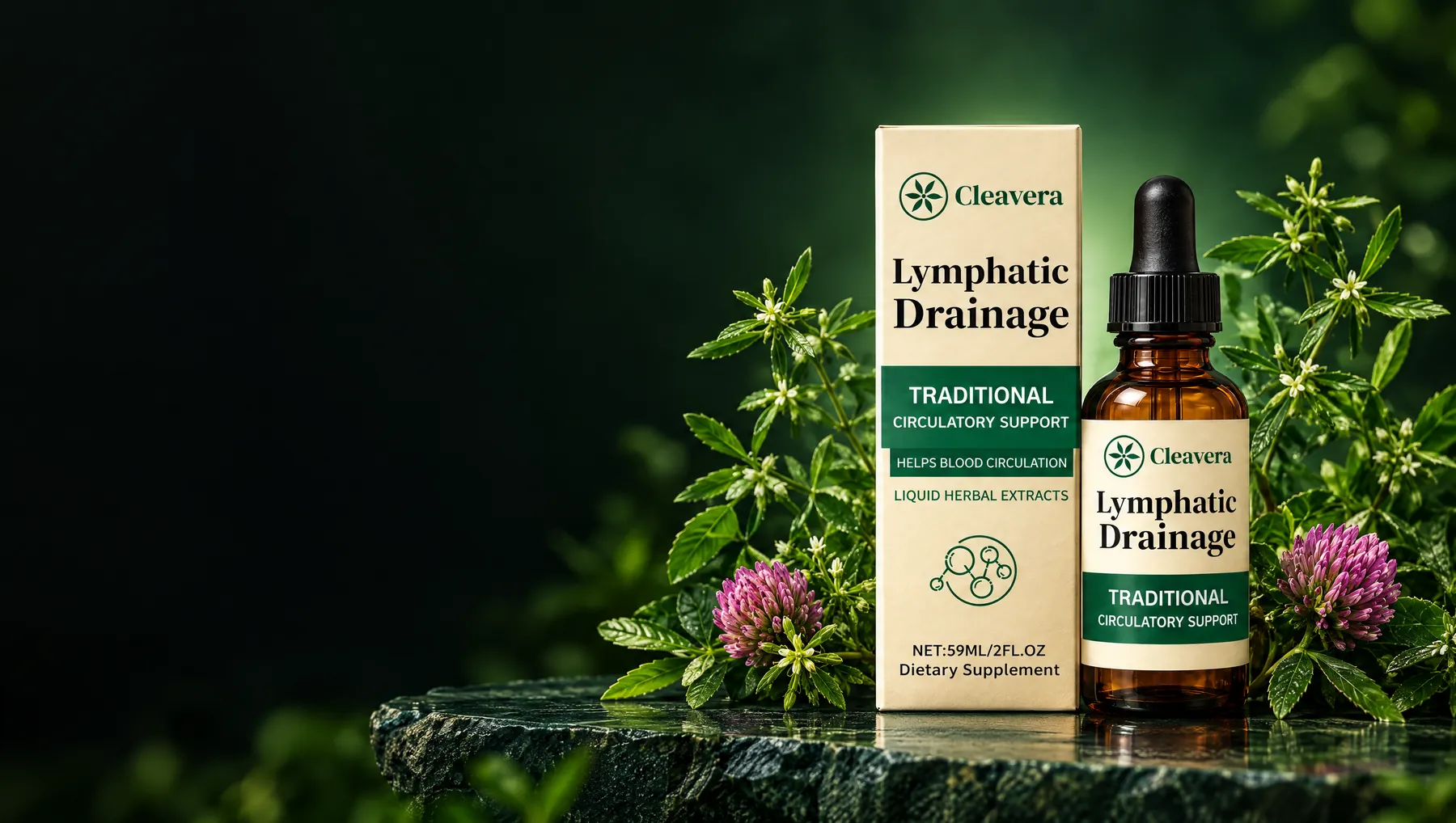
Try the four-herb formula
Cleavers, red clover, stillingia and prickly ash in an alcohol-free extract. One mL, twice a day.* Free US shipping over $50 and a 60-day money-back guarantee on your first order.