Long Flights and Road Trips: How to Keep Your Circulation Moving
Hours in a cramped seat leave your calves with little to do. Here’s how to keep moving on planes, trains and road trips, what the CDC says about travel and blood clots, and the warning signs worth knowing.
A 10-hour flight, a cross-country drive or an overnight bus can mean hours with your knees bent and your calves barely moving. For most people, that just means stiff legs. For a small number, it can contribute to a blood clot.
Below: how to keep moving in transit, who should see a doctor first, and the warning signs to know afterward. For long workdays, see our 5-minute desk routine for healthy circulation.
Why does long travel slow your circulation?
Sitting for hours with bent knees and little room keeps your calf muscles still, and those muscles are what squeeze blood up the veins of your legs toward your heart. With less of that squeeze, blood moves more slowly through the deep leg veins.
Cleveland Clinic describes the lower leg muscles as a powerful pump for the deep veins, one that only works when your legs move. The CDC’s travel health guide, the Yellow Book, puts it plainly: immobility while flying is a risk for venous thromboembolism (VTE), the umbrella term for clots in the veins.
VTE covers two related problems. Deep vein thrombosis (DVT) is a clot in a deep vein, usually in the leg. A pulmonary embolism (PE) happens when part of a clot breaks away and travels to the lungs, a medical emergency. The CDC says anyone traveling more than four hours, by air, car or bus, can be at risk, and the NHS includes long train journeys too.
How common are blood clots after long flights?
For most travelers, they’re uncommon. The CDC’s Yellow Book cites studies finding about one clot for every 4,656 to 6,000 person-flights on flights longer than four hours, and calls the risk on flights under four hours negligible.
Long-distance air travel may raise the overall risk two- to fourfold, though the data are inconsistent, and the risk doesn’t end at the arrivals gate: most travel-related clots show up within one to two weeks of a flight. Still, the CDC says that even on a long trip, the risk of a clot is generally very small. For a healthy traveler, a long flight isn’t a reason to worry, but it is a reason to move.
Who is at higher risk of a blood clot when traveling?
Your risk is higher if you already have a clot risk factor, such as a previous clot, recent surgery, pregnancy or estrogen-containing birth control. If any apply, talk to your doctor before a trip of four hours or more.
The CDC’s list of risk factors for travel-related clots includes:
- being over 40
- overweight or obesity
- surgery or injury in the last three months
- estrogen-containing birth control (pills, rings or patches) or hormone replacement therapy
- pregnancy, and the first three months after giving birth
- a previous blood clot, an inherited clotting disorder or a family history of clots
- certain serious illnesses under active medical care now or recently, and long-term conditions such as heart or lung conditions or diabetes
- limited mobility, such as a leg in a cast
- a catheter placed in a large vein
- varicose veins
The Yellow Book adds that travelers shorter than about 5 feet 3 inches (1.6 m) or taller than about 6 feet 3 inches (1.9 m) may also be at increased risk. If you’re pregnant or planning to be, our guide to lymphatic drops in pregnancy and breastfeeding explains why Cleavera isn’t for you right now.
How do you keep circulation moving on a long flight?
Walk the aisle every one to two hours when the seatbelt sign is off, and work your calves in your seat between walks.
- Book an aisle seat. The Yellow Book says an aisle seat might be protective; in research it cites, travelers in window seats had about twice the risk. Mostly, it lets you get up without climbing over anyone.
- Walk every one to two hours. A lap to the galley is enough. Stay seated when the seatbelt sign is on.
- Keep the floor in front of you clear. A bag at your feet stops you from stretching your legs.
- Wear loose clothes. The NHS suggests loose clothing for journeys of four hours or more, and shoes you can loosen help too.
- Drink water, and go easy on alcohol. The NHS advises both for long journeys. The Yellow Book notes there’s no direct evidence either lowers clot risk, but alcohol can make you sleepier and less likely to move.
Which exercises can you do in your seat?
Ankle pumps, heel raises, ankle circles and knee lifts all keep your calves working when you can’t get up. Passengers can repeat this short routine every 30 minutes or so; drivers should save it for rest stops.
- Ankle pumps. With your heels on the floor, lift your toes toward your shins, then press them down. Repeat 10 to 20 times.
- Heel raises. Keep the balls of your feet on the floor and lift both heels as high as you can, then lower them. Repeat 10 to 20 times.
- Ankle circles. Lift one foot slightly and circle it slowly, about 8 times each way, then switch.
- Knee lifts. The CDC notes that some airlines suggest pulling each knee up toward your chest, holding it with your hands on your lower leg for 15 seconds, and repeating up to 10 times.
- Leg stretches. When there’s room, straighten one leg under the seat in front and flex your foot back toward you for a few seconds. Switch legs.
How do you keep circulation moving on a road trip?
Plan a stop every one to two hours and walk for a few minutes each time. Passengers can do the seated routine above; drivers should save their stretches for stops.
Build stops into your route before you set off. At each one, walk to the far end of the parking lot and do 10 calf raises with a hand on the car.
| Trip | Seat | When to get up | While seated |
|---|---|---|---|
| Long flight | Aisle | Every 1–2 hours, when the seatbelt sign is off | Ankle pumps, heel raises and knee lifts every 30 minutes or so |
| Car, driving | Driver’s seat | Stop and walk every 1–2 hours | Nothing while driving; stretch at stops |
| Car, passenger | Wherever you can stretch your legs | Get out at every stop | The full seated routine |
| Train or bus | Aisle | Walk every 1–2 hours or at every stop | The full seated routine |
Should you wear compression socks on a long flight?
Only if your doctor suggests them. Graduated compression stockings are recommended for travelers at increased risk of clots, not for everyone, and they need to fit properly.
The CDC’s Yellow Book says these stockings appear to reduce clots that cause no symptoms in travelers and are generally well tolerated. The American College of Chest Physicians recommends properly fitted, below-the-knee stockings giving 15 to 30 mmHg of pressure at the ankle for travelers at increased risk on trips over six hours, but not for travelers without increased risk.
The same goes for medicine: don’t start aspirin or anything else for a trip on your own, and if you already take a blood thinner, follow your doctor’s instructions.
What are the warning signs of a blood clot after travel?
Watch for pain, swelling, warmth or redness in one leg or arm in the weeks after a long trip, and contact a doctor as soon as possible if you notice them. Sudden shortness of breath or chest pain needs emergency care right away.
Possible clot in a leg or arm (DVT): swelling, pain or tenderness you can’t explain, skin that feels warm, or redness or discoloration, usually on one side. Contact your doctor as soon as possible.
Possible clot in the lungs (PE): trouble breathing, a fast or irregular heartbeat, chest pain that gets worse with a deep breath or cough, coughing up blood, or feeling lightheaded or faint. Call 911 or get emergency help immediately.
Skip a move, or ask your clinician first, if it hurts, or if you have a known or suspected blood clot, recent surgery, a heart or kidney condition, an active infection or fever, or a serious illness under active medical care.
About half of people with DVT have no symptoms, the CDC notes, so mention a recent long trip to any doctor you see in the weeks afterward. Swelling in both legs that won’t settle deserves a check too.
Can you take herbal drops when you travel?
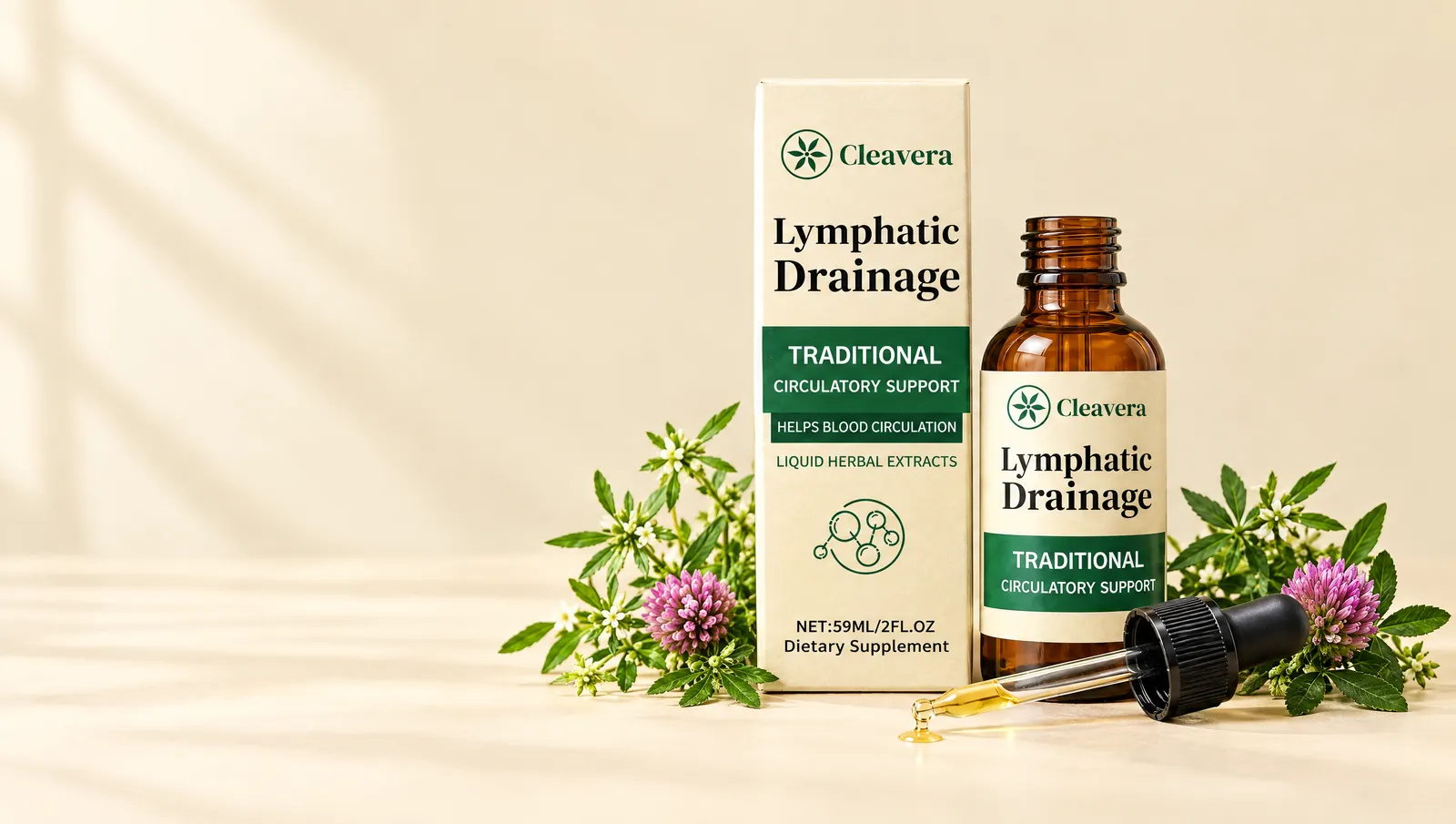
Yes, if they suit you at home. Cleavera’s 59 mL (2 fl oz) bottle is under the TSA’s 3.4-ounce (100 mL) limit for carry-on liquids, so it fits in your quart-sized liquids bag.
Keep the cap tight and the bottle out of direct sun and hot cars (our guide to storing herbal drops has more), and add 1 mL to a bottle of water after security. Our guide on how to take lymphatic drainage drops covers timing.
Cleavera Lymphatic Drainage Drops combine four herbs traditionally used to support healthy circulation and lymphatic flow.* They aren’t a way to lower your risk of blood clots, and they don’t replace walking the aisle, stockings your doctor recommends or any prescribed medicine. If you take a blood thinner, check with your doctor before using any herbal product, including ours; our FAQ and guide to who should skip lymphatic drops explain why.
Frequently asked questions
Is sleeping through a long flight bad for circulation?
Hours of sleep in a cramped seat are hours without calf movement, and the CDC’s Yellow Book names immobility while flying as a risk for clots. You don’t need to stay awake. Walk and stretch before you settle in, sleep with your legs as straight as the space allows, and move again as soon as you wake.
How long after a flight can a blood clot appear?
Most travel-related clots appear within the first one to two weeks after a flight, according to the CDC’s Yellow Book, and the added risk returns to baseline by about eight weeks. If you notice leg pain, swelling or breathlessness in that window, tell your doctor about your recent trip.
Does drinking more water lower the risk of blood clots on a flight?
There’s no direct evidence that it does. The CDC’s Yellow Book says no link has been shown between dehydration and travel-related clots, though staying hydrated is reasonable and unlikely to cause harm. Drink water for comfort, and let the refills and bathroom trips double as reasons to get up.
Can you fly after a blood clot?
Only with your doctor’s go-ahead. The NHS advises waiting until at least two weeks after you start blood-thinning medicine before flying or taking other long journeys. Your doctor may also suggest compression stockings or other steps for the trip, based on your history.
Is long-distance travel riskier during pregnancy?
Pregnancy, and the first three months after giving birth, are on the CDC’s list of risk factors for travel-related blood clots. Talk to your midwife or doctor before a long trip, and ask whether you need anything beyond walking breaks, seated exercises and loose clothing.
Sources
- Centers for Disease Control and Prevention. “Understanding Your Risk for Blood Clots with Travel.” cdc.gov/blood-clots/risk-factors/travel
- Centers for Disease Control and Prevention, CDC Yellow Book 2026. “Deep Vein Thrombosis and Pulmonary Embolism.” cdc.gov/yellow-book/…/deep-vein-thrombosis-and-pulmonary-embolism
- NHS. “DVT (deep vein thrombosis).” nhs.uk/conditions/deep-vein-thrombosis-dvt
- Cleveland Clinic. “Veins: Anatomy and Function.” my.clevelandclinic.org/health/body/23360-veins
- Transportation Security Administration. “Liquids, Aerosols, and Gels Rule.” tsa.gov/travel/security-screening/liquids-aerosols-gels-rule