How Much Water Should You Drink a Day? Hydration & Your Lymph
The official numbers are more generous, and more flexible, than the eight-glasses rule. Here’s how much water adults need, what counts toward it, how to tell you’re on track, and what hydration has to do with your lymphatic system.

Few wellness questions get as many confident, conflicting answers as this one. Eight glasses. Half your body weight in ounces. A gallon a day. The guidance from nutrition scientists is simpler than any of those rules, and it leaves room for the fact that your needs change with the weather, your workout and your health.
Below, we walk through the official intake numbers, how to tell whether you’re drinking enough, and what hydration has to do with your lymphatic system, the network that collects a colorless, watery fluid from your tissues and returns it to your blood.
How much water should you drink a day?
For healthy adults, the National Academies set an adequate intake of about 2.7 liters of total water a day for women and 3.7 liters for men. “Total water” means everything: plain water, other drinks and the water in your food.
The figures come from the 2004 Dietary Reference Intakes for water, which based the adequate intake on what healthy, well-hydrated people actually take in each day.
In everyday measures, 2.7 liters is about 91 ounces, or roughly 11.5 cups, and 3.7 liters is about 125 ounces, or roughly 15.5 cups. Because food supplies part of that, the amount you need to drink is lower. Harvard T.H. Chan School of Public Health’s Nutrition Source translates the drinks portion into about 9 cups a day for women and 13 cups for men, counting 1 cup as 8 ounces.
| Daily guide for healthy adults | Women (19+) | Men (19+) |
|---|---|---|
| Total water from food and drinks | About 2.7 L (91 oz) | About 3.7 L (125 oz) |
| The same total in cups | About 11.5 cups | About 15.5 cups |
| From drinks | About 9 cups (72 oz) | About 13 cups (104 oz) |
| From food | Roughly 20 percent | Roughly 20 percent |
Harvard’s table also lists about 10 cups of fluids a day during pregnancy and about 13 cups while breastfeeding. It’s careful to call all of these amounts a general guide rather than a daily target.
Does food count toward your daily water?
Yes. Food supplies roughly a fifth of the water most people take in, according to the National Academies, while the other 80 percent comes from drinking water and other beverages.
Fruits and vegetables do most of that work. Harvard’s Nutrition Source points to lettuce, cucumbers and melons, and the CDC notes that foods with a high water content, including many fruits and vegetables, add to your fluid intake. MedlinePlus adds liquid foods such as soup and milk to the list.
Plain water is a smaller slice than most people assume. In a CDC analysis of national survey data from 2009 to 2012, plain water made up about 30 percent of men’s total water intake and 34 percent of women’s. The rest came from other drinks and food. Your whole day of eating and drinking counts, and our guide to foods for healthy lymph flow goes deeper on water-rich produce.
Do tea and coffee count toward hydration?
They do. The National Academies concluded that caffeinated drinks can contribute to daily water intake as much as non-caffeinated ones, because caffeine’s diuretic effect appears to be short-lived.
Harvard adds that more than about 180 mg of caffeine a day, roughly two cups of brewed coffee, may increase urination in the short term for some people but won’t necessarily lead to dehydration. Herbal tea, milk, sparkling water and broth all count as fluids. Alcohol is the exception. MedlinePlus explains that alcohol acts as a diuretic, causing the body to release water, so alcoholic drinks don’t add to your fluid total. The CDC still suggests choosing water over sugary drinks.
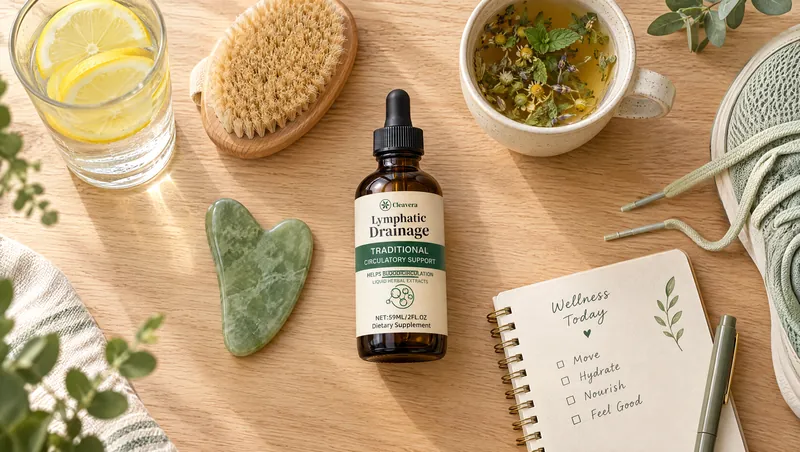
If you like herbal tea, it’s an easy way to make fluids feel like a ritual. Cleavera’s directions call for 1 mL added to your favorite drink, and a warm mug works well. Our guide to how to take lymphatic drainage drops covers timing and mixing.
How can you tell if you’re drinking enough?
For most healthy adults, two everyday signals work well: you rarely feel thirsty, and your urine is pale yellow rather than dark. The National Academies concluded that most people can meet their daily needs by letting thirst be their guide.
- Urine color and volume. Harvard notes that urine darkens the more concentrated it is, and that smaller amounts of darker urine may point to dehydration. Some foods, medicines and vitamin supplements change urine color too, so read color as a rough guide.
- Thirst. A dependable cue for most adults, but Harvard notes it can be less reliable in older adults, athletes, people who are ill and infants.
- How you feel. According to Harvard, even a 2 percent water deficit may bring fatigue, confusion or short-term memory trouble, and mood changes such as irritability.
One caveat for older adults: Harvard cites a review that found urine color and volume alone aren’t effective ways to spot dehydration in older people. If you care for an older relative, regular drinks offered through the day work better than waiting for thirst.
When do you need more water than usual?
You need more fluid whenever you lose more: in hot weather, when you’re more active, and when you have a fever, vomiting or diarrhea, according to the CDC. Pregnancy and breastfeeding raise needs too.
The National Academies note that very physically active people and those who live in hot climates may need more than the adequate intake. If you’re sick and can’t keep fluids down, or you feel dizzy or confused, contact a healthcare professional.
Does drinking water help your lymphatic system?
Staying hydrated supports the normal fluid balance your lymphatic system works within. We’re not aware of research showing that drinking extra water beyond your needs makes lymph flow faster, so the honest answer is to drink enough, not more.
Here’s how the two connect. According to the Cleveland Clinic, about 20 liters of plasma, the liquid part of your blood, seep out of your tiny capillaries into the surrounding tissues each day. About 17 liters return straight to the bloodstream. Your lymphatic system picks up the remaining 3 liters or so, now called lymph, and carries it back to your circulation.
Lymph itself is a colorless, watery fluid, and the Cleveland Clinic’s advice for a healthy lymphatic system includes drinking plenty of water so lymph can move easily through your body. MedlinePlus describes the bigger principle: the water you take in should equal the water you lose, with electrolytes such as sodium and potassium helping to balance the amount of water in your body.
What water can’t do is replace movement. Lymph has no heart pushing it. The Cleveland Clinic explains that the squeezing of nearby muscles and the pulsing of nearby arteries help it along, while one-way valves keep it heading in the right direction. Our explainer on how lymph moves walks through the mechanics, and 7 lymphatic system myths, fact-checked looks at popular claims about water and lymph.
Can you drink too much water?
Yes, though it’s rare in healthy adults. Drinking a very large amount in a short time, faster than your kidneys can clear it, can dilute the sodium in your blood, a condition called hyponatremia.
Harvard notes that there’s no official upper limit for water, because healthy kidneys usually excrete the excess. The risk rises during prolonged, strenuous exercise or extreme heat, especially for endurance athletes who also lose sodium in sweat, and for people whose kidneys don’t work properly. Symptoms can include confusion, nausea, seizures and muscle spasms. In practice, that means sipping steadily through the day rather than forcing down liters at once, and never turning a gallon-a-day challenge into a goal.
What are easy ways to drink more water?
Make water the easiest drink within reach: keep a refillable bottle nearby, drink with meals, and flavor it naturally if plain water bores you. Small, repeatable habits work better than a daily total you have to chase.
- Carry a refillable bottle. Harvard suggests a 20- to 32-ounce bottle. Filling a 20-ounce bottle four times gives you 80 ounces.
- Pair water with meals. The CDC recommends serving water during meals and choosing it when you eat out.
- Add flavor, not sugar. A wedge of lemon or lime, a few cucumber slices, or sparkling water with just an ounce or two of juice.
- Lean on tea. A warm herbal tea in the afternoon or evening counts toward your fluids.
- Attach it to habits you already have. If you take Cleavera, its 1 mL twice-daily serving gives you two built-in reminders to finish a full glass.
For more ways to build water into your day alongside walking, breathing and sleep, see our 10 daily habits for healthy lymph flow.
Where Cleavera fits
Cleavera’s label pairs its directions with a simple reminder: use consistently and stay hydrated. Stirring your 1 mL serving into a full glass of water or tea twice a day turns your drops into two small water breaks. Its four herbs, cleavers, red clover, stillingia and prickly ash, are traditionally used to support healthy lymphatic flow,* but no supplement replaces fluids, movement or rest. Read about each plant in our ingredient guide, learn how lymphatic drainage drops work, or see the full label on the Lymphatic Drainage Drops page.
Some people need personal fluid advice. If you have a heart, kidney or liver condition, take diuretics or other medicines that affect fluid balance, or have been told to limit fluids, follow your clinician’s guidance rather than general targets. See a doctor promptly about new swelling, especially in one arm or leg, or swelling with pain, redness or warmth. Cleavera is for adults. Talk to your healthcare professional before use if you’re pregnant or nursing, take medication (including blood thinners or hormone therapy), have a hormone-sensitive or bleeding condition, or have surgery scheduled. Our guide to side effects and who should skip lymphatic drops has more.
Frequently asked questions
Is sparkling water as hydrating as still water?
For everyday purposes, yes. The Dietary Guidelines for Americans, 2025–2030 recommend choosing water, still or sparkling, along with unsweetened drinks. Plain sparkling water counts toward your fluid total just like tap water. Flavored versions can contain added sugars or sweeteners, so check the label, and switch to still water if the bubbles bother you.
Does the “8 glasses a day” rule still apply?
It’s a handy reminder, not an official rule. Eight 8-ounce glasses is about 1.9 liters. For many adults the drinks portion of the National Academies’ intake is higher, about 9 cups for women and 13 for men, while food supplies the rest. Your own needs depend on your size, activity, climate and health.
Do I need electrolyte drinks to stay hydrated?
Most people don’t need them for everyday life, since food is the main source of sodium and potassium. The Dietary Guidelines for Americans note that sodium and electrolytes are essential for hydration and that highly active people may benefit from more sodium to offset sweat losses. If you exercise hard for long periods in the heat, ask a clinician or sports dietitian what suits you.
How many ounces or liters are in a cup of water?
In US nutrition guidance, a cup is 8 fluid ounces, or about 240 milliliters. That makes 9 cups 72 ounces, a little over 2 liters, and 13 cups 104 ounces, a little over 3 liters. A standard 500 mL bottle of water holds about 2 cups.
Can I add lymphatic drops to my water?
Yes. Cleavera’s directions are 1 mL twice daily added to your favorite drink, so a glass of water, a mug of tea, juice or a smoothie all work, or you can take it straight. Measure with the dropper’s 1 mL marking or ¼ teaspoon, and keep the dropper from touching your glass or mouth.
Sources
- National Academies of Sciences, Engineering, and Medicine. “Report Sets Dietary Intake Levels for Water, Salt, and Potassium to Maintain Health and Reduce Chronic Disease Risk.” nationalacademies.org/news
- Harvard T.H. Chan School of Public Health, The Nutrition Source. “Water.” nutritionsource.hsph.harvard.edu/water
- Centers for Disease Control and Prevention. “About Water and Healthier Drinks.” cdc.gov/healthy-weight-growth/water-healthy-drinks
- CDC National Center for Health Statistics. “Daily Water Intake Among U.S. Men and Women, 2009–2012.” cdc.gov/nchs/products/databriefs/db242
- MedlinePlus, U.S. National Library of Medicine. “Water in diet.” medlineplus.gov/ency/article/002471
- MedlinePlus, U.S. National Library of Medicine. “Fluid and Electrolyte Balance.” medlineplus.gov/fluidandelectrolytebalance
- Cleveland Clinic. “Lymphatic System: Function, Conditions & Disorders.” my.clevelandclinic.org/health/body/21199-lymphatic-system
- U.S. Department of Agriculture and U.S. Department of Health and Human Services. “Dietary Guidelines for Americans, 2025–2030.” cdn.realfood.gov/DGA.pdf