Facial Lymphatic Drainage Massage: A Step-by-Step Guide
A slow, feather-light routine for your face and neck: where to begin, how much pressure to use, whether you need a tool, and when to leave your face alone.

Facial lymphatic massage may be the gentlest few minutes in a skin care routine: no scrubbing, nothing to buy, just slow strokes in the direction lymph already travels. Our gentle habits for a puffy morning face cover sleep, salt and cool water, and our guide to lymphatic drainage massage at home covers the neck, chest and arms. This guide goes deeper on the face: where its lymph goes, the order of strokes, how light “light” is, tools, and when to skip it.
What is facial lymphatic drainage massage?
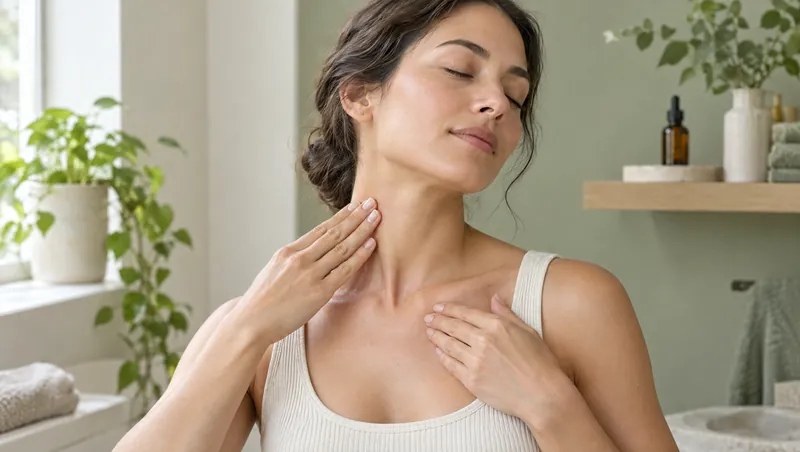
Facial lymphatic drainage massage is a very light, slow massage that stretches the skin of your face in the direction lymph naturally flows: outward from the middle of your face, then down your neck toward your collarbones.
It borrows its style from manual lymphatic drainage (MLD), a specialized therapy used in medical care, but the home version is simply self-care. It targets tiny lymph vessels just beneath the skin rather than muscle, so it uses barely any pressure. Cleveland Clinic notes that lymphatic massage has become a popular cosmetic service and says facial lymphatic drainage may increase blood circulation in the face.
Where does lymph from your face drain?
Lymph from your face drains to small lymph nodes under your chin, along your jaw, in front of your ears and down the sides of your neck. From there it travels to the base of your neck, where it rejoins your bloodstream.
According to StatPearls, a National Library of Medicine reference, lymph from the face tends to drain to whichever is closer of the submental (under the chin), submandibular (under the jaw) and cervical (neck) nodes, with preauricular nodes sitting near the ears. MedlinePlus lists the neck, under the jaw and chin, and behind the ears among the places where lymph nodes can be felt. Every stroke heads toward one of these groups. Our map of where your lymph nodes are covers the rest of the body.
| Area | Which way to stroke | Tip |
|---|---|---|
| Neck and collarbones | Down the sides of the neck toward the collarbones | Start and finish here |
| Jaw and chin | From the center of the chin out along the jaw toward the ear | Flat fingers, not fingertips |
| Cheeks | From beside the nose outward toward the ear | Move the skin, not the muscle |
| Under the eyes | From the inner corner outward toward the temple, along the bone | Ring finger, barely any pressure |
| Forehead | From the center of the brow outward toward the temples | Slow strokes in one direction |
Why do you start facial lymphatic massage at the neck?
You start at the neck because that’s where lymph from your head flows back toward your blood. Cleveland Clinic explains that lymphatic drainage begins around lymph node areas, such as the neck, before moving outward. No one has tested whether the order matters in a healthy face, but it gives each stroke somewhere to go and sets an unhurried pace.
How to do facial lymphatic drainage massage, step by step
The full routine takes 8 to 10 minutes. Go slowly, about one stretch every second or two, and lift your fingers away after each stroke instead of sliding them back.
- Prepare your skin. Wash your hands and face and pat dry. Work on bare skin, or after a light moisturizer has sunk in, so your fingers stretch the skin instead of sliding.
- Breathe and relax. Sit tall, drop your shoulders and take five slow belly breaths.
- Open the collarbones. Rest two flat fingers in the hollows just above your collarbones. Gently stretch the skin down and inward, then release. Repeat 10 times.
- Stroke down your neck. With your palms flat just below your ears, slowly stretch the skin down toward your collarbones and release. Repeat 10 times, keeping off the front of your throat.
- Circle in front of your ears. With two flat fingers just in front of each ear, make small, slow circles that stretch the skin down and back. Repeat 5 to 10 times.
- Sweep along the jaw. From the center of your chin, stretch the skin outward along your jawline in three short moves toward the angle of your jaw, then stroke down your neck. Repeat 5 times.
- Sweep across the cheeks. From beside your nose, stretch the skin outward toward your ears, then repeat from the middle of your cheeks. Finish with a stroke down in front of your ears and along your neck. Repeat 5 times.
- Glide under the eyes. With your ring finger on the bony rim at the inner corner of each eye, glide outward toward your temple with barely any pressure, 3 to 5 times. Stay off your eyelids.
- Smooth the forehead. From the center of your brow, stretch the skin outward toward your temples, then stroke gently down in front of your ears. Repeat 5 times.
- Finish at your neck. Repeat steps 4 and 3 five times each, then sit quietly for a moment.
Short on time? Steps 3, 4 and 7 make a two-minute version. To add a tool, our guide to how to use gua sha follows the same map with a smooth stone.
How much pressure should you use on your face?
Use just enough pressure to move your skin over what lies beneath it, about as much as you’d use to smooth a silk scarf. If you feel muscle or bone, or your skin turns more than faintly pink, you’re pressing too hard.
- Use flat fingers, not fingertips, to spread the pressure.
- Stretch, then release. Don’t glide across the skin.
- Lighten up near your eyes, where skin is thinnest. Your ring finger is your weakest, which makes it the right one.
It should feel soothing and never hurt or leave marks. Cleveland Clinic notes that a few people feel tired, headachy or slightly nauseous after lymphatic massage; if so, rest, drink some water and keep the next session shorter.
Should you use your hands or a tool?
Your hands are the best place to start, because flat fingers stretch the skin gently and tell you exactly how hard you’re pressing. Rollers and gua sha stones are optional. They glide rather than stretch, so they need a little oil or serum and an even lighter touch.
Tools do change skin blood flow, briefly. In a 2018 study in Complementary Therapies in Medicine, five minutes with a facial roller raised blood flow in the rolled cheek for at least 10 minutes in 12 adults, and five weeks of daily rolling changed how that cheek’s blood vessels responded to warmth in another 14. Neither experiment measured lymph.
Does facial lymphatic drainage massage actually work?
For healthy people, there’s little rigorous research. Small studies suggest facial massage can be relaxing and can briefly increase skin blood flow, but none show lasting changes to the shape of your face.
- Relaxation. In a 2008 study in Biomedical Research, 32 healthy women had lower anxiety and negative-mood scores after a 45-minute facial massage. There was no comparison group, so it’s a signal, not proof.
- Clinical facial drainage. Most research involves people recovering from facial surgery. In a 2020 trial of 26 people after jaw surgery, six professional lymphatic drainage sessions on top of standard care made no statistically significant difference to swelling or pain.
Many people say their face feels softer and warmer, and that they feel calmer afterward. Morning puffiness also settles on its own once you’re up and moving, so before-and-after photos are hard to judge. For more, see our fact-check of seven lymphatic system myths.
How often should you do a facial lymphatic massage?
There’s no proven schedule. A few minutes daily, or a few times a week, is a reasonable rhythm, morning or evening. If your skin turns red, feels tender or breaks out, take a few days off and come back with lighter pressure.
Who should skip facial lymphatic massage?
Skip it on skin that’s broken, irritated, sunburned, infected or flaring, and ask first if you have a skin condition or a recent facial procedure.
- Rosacea. The American Academy of Dermatology (AAD) advises people with rosacea to avoid rubbing, scrubbing or massaging their skin, since anything that irritates it can trigger a flare.
- Acne or a rash. Work around breakouts, or wait until a flare settles.
- Fillers and injectables. The AAD advises avoiding touching filler-treated areas for three days unless your dermatologist gives you massage instructions. After injectables, lasers, peels or facial surgery, follow your provider’s aftercare.
- Health conditions. Cleveland Clinic lists blood clots, cellulitis, fever, infection, heart disease, kidney failure and stroke as reasons to avoid lymphatic drainage massage.
Skip it, or ask your clinician first, if you have an active infection or fever, broken or irritated skin, known or suspected blood clots, a heart or kidney condition, a serious illness under active medical care, or recent surgery. Stop if anything hurts.
See a doctor about any new swelling, especially on one side of your face or neck, or swelling that comes with pain, redness or warmth. Get emergency care for facial swelling with hives or trouble breathing.
Where does facial massage fit in a daily routine?
Facial massage is a finishing touch on the habits that do the daily work: moving, breathing deeply, drinking water and sleeping well. See our 10 daily habits for healthy lymph flow and the best exercise for lymph flow.
Some people also enjoy a daily herbal ritual. Cleavera Lymphatic Drainage Drops combine cleavers, red clover, stillingia and prickly ash, four herbs traditionally used to support healthy lymphatic flow.* Stir 1 mL into water or tea twice a day. Meet the plants on our ingredients page, and check who should skip lymphatic drops first.
Frequently asked questions
Can facial lymphatic massage make your face slimmer?
There’s no good evidence that it can. The shape of your face comes mostly from bone, muscle and the deeper tissues beneath your skin, and a feather-light massage doesn’t change those. Some people find their face looks more rested afterward, but that tends to be brief.
Do you need oil for facial lymphatic massage?
Not when you use your hands. The aim is to stretch the skin gently, and oil makes your fingers slide instead. Work on clean, bare skin or after a light moisturizer has sunk in. If you use a roller or gua sha stone, you do need a few drops of oil or serum so the tool glides without tugging.
Can you do facial lymphatic massage after Botox or fillers?
Wait, and ask your provider first. The American Academy of Dermatology advises avoiding touching areas treated with filler for three days unless you’re given massage instructions. Aftercare differs between products and procedures, so your injector or dermatologist should tell you when gentle massage is fine again.
Should you be able to feel lymph nodes when you massage your face?
Usually not. Healthy lymph nodes are small and often hard to feel, and lymphatic massage works on the skin, not on the nodes themselves. MedlinePlus advises contacting a provider about a node that feels hard or fixed in place, keeps growing, or hasn’t shrunk after several weeks.
Sources
- StatPearls, NCBI Bookshelf (Nguyen JD, Duong H). “Anatomy, Head and Neck: Face.” 2023. ncbi.nlm.nih.gov/books/NBK551530
- MedlinePlus Medical Encyclopedia (NIH National Library of Medicine). “Swollen lymph nodes.” medlineplus.gov/ency/article/003097.htm
- Cleveland Clinic. “Lymphatic Drainage Massage.” my.clevelandclinic.org/health/treatments/21768-lymphatic-drainage-massage
- Biomedical Research (Hatayama T, et al.). “The facial massage reduced anxiety and negative mood status, and increased sympathetic nervous activity.” 2008. pubmed.ncbi.nlm.nih.gov/19129675
- Complementary Therapies in Medicine (Miyaji A, et al.). “Short- and long-term effects of using a facial massage roller on facial skin blood flow and vascular reactivity.” 2018. pubmed.ncbi.nlm.nih.gov/30477852
- Oral Surgery, Oral Medicine, Oral Pathology and Oral Radiology (Van de Velde FEG, et al.). “The effect of manual lymphatic drainage on patient recovery after orthognathic surgery: a qualitative and 3-dimensional facial analysis.” 2020. pubmed.ncbi.nlm.nih.gov/32680812
- American Academy of Dermatology. “7 rosacea skin care tips dermatologists recommend.” aad.org/public/diseases/rosacea/triggers/tips
- American Academy of Dermatology. “Fillers: FAQs.” aad.org/public/cosmetic/wrinkles/fillers-faqs